-
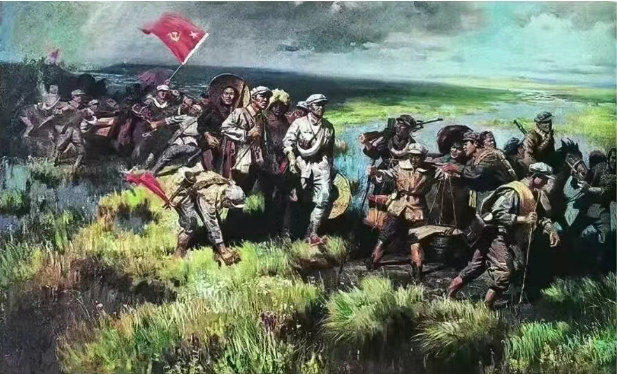
The CPC Central Committee and the Central Revolutionary Military Commission lead the main forces of the Central Red Army to make a strategic shift and start the Long March. From mid-November to mid-November 1935, the 25th Red Army, the Fourth Front Red Army, and the Second and Si...[MORE]
-
The Central Red Army breaks through three consecutive blockades of the KMT army, and suffers major losses in the Battle of the Xiang River, the fourth blockade. After crossing the Xiang River, the Central Red Army is sharply reduced from more than 86,000 troops at the start of th...[MORE]
-
The CPC Central Committee’s Political Bureau holds a meeting in Liping, Guizhou, and passes a resolution, based on Mao Zedong’s proposal, to abandon the plan to rendezvous with the Second and Sixth Army Groups of the Red Army in northwestern Hunan and instead march to northern ...[MORE]
-
The CPC Central Committee’s Political Bureau holds an enlarged meeting in Zunyi, Guizhou, to focus on military and organizational issues of decisive importance at the time. The meeting co-opts Mao Zedong as a member of the Standing Committee of the Central Committee’s Political...[MORE]
-
The Central Red Army crosses the Chishui River four times, crosses to the south side of the Wu River, feigns an attack on Guiyang, presses on to Kunming, and crosses the Jinsha River, thus foiling encirclements, pursuits, obstructions and interceptions by hundreds of thousands of...[MORE]
-
The Red Army in northern Shaanxi, under the command of Liu Zhidan and others, crushes the enemy’s military encirclement and suppression and makes the Shaanxi-Gansu Border and the Northern Shaanxi bases into one, forming the Shaanxi-Gansu Revolutionary Base (also known as the Nor...[MORE]
-
The Central Red Army scale the snow-covered Jiajin Mountain and rendezvouses with the Fourth Front Red Army in Maogong, Sichuan. According to the situation after the rendezvous, the CPC Central Committee adopts the strategy of going north to establish the Sichuan-Shaanxi-Gansu Re...[MORE]
-
The CPC delegation to the Communist International drafts the Appeal to All Fellow-Countrymen for Resistance against Japanese Aggression and for National Protection by the Chinese Soviet Central Government and the CPC Central Committee (also known as the August 1st Declaration). T...[MORE]
-
The 25th Red Army arrives at the Shaanxi-Gansu Revolutionary Base, rendezvousing with the local 26th and 27th Red Armies. These armies are combined to form the 15th Army Group of the Red Army, with Xu Haidong as commander and Cheng Zihua as political commissar.Source From: CHRONI...[MORE]
-
The First and Third Red Armies and the Military Commission Column move north and arrive in Hadapu, Gansu, and they are formally reorganized as the Shaanxi-Gansu Detachment, with Peng Dehuai as commander and Mao Zedong as political commissar. On October 19, the detachment arrives ...[MORE]
-
As Japan intensifies its invasion of north China, the CPC leads the students in Beiping to launch a powerful counter-Japanese movement (known as the December 9th Movement), which quickly spreads throughout the country and forms a new climax of counter-Japanese national salvation....[MORE]
-
The Central Committee’s Political Bureau holds an enlarged meeting at Wayaobu in northern Shaanxi Province to determine the strategy of establishing a Chinese United Front against Japanese Aggression. After the meeting, Mao Zedong makes a report, systematically elaborating this ...[MORE]
-
The First Front Red Army launches the Eastern Campaign in Shanxi, Suiyuan and other places and the Western Campaign in the Shaanxi-Gansu-Ningxia border region.Source From: CHRONICLE OF THE COMMUNIST PARTY OF CHINA (JULY 1921–JUNE 2021), by Institute of Party History and Literatu...[MORE]
-
The Second and Sixth Armies of the Red Army arrive in Garzê of Sichuan during the Long March and rendezvous with the Fourth Front Red Army. On July 5, the Second Front Red Army is established, with He Long as commander-in-chief and Ren Bishi as political commissar. Thanks to the ...[MORE]
-
The First and Fourth Front Red Armies rendezvous in Huining, Gansu. On October 22, the First and Second Front Red Armies rendezvous at Jiangtaibu, Longde, Gansu (now part of Xiji, Ningxia). So far, the three main forces of the Red Army have rendezvoused. The Long March is a great...[MORE]
-
In order to open up a route to access assistance from the Soviet Union, a part of the Fourth Front Red Army receives instructions from the Central Revolutionary Military Commission to cross the Yellow River to the west and prepare for a campaign in Ningxia. On November 11, in acc...[MORE]