
Overcoming the Splittism of Zhang Guotao and Joining the Forces of the First, Second, and Fourth Front Armies
2026-10-17 13:18:41
After crossing the Jinsha River, the Central Red Army continued north. When it entered an area inhabited by the Yi ethnic group in the Daliang Mountains, Liu Bocheng, army chief of staff, formed an alliance with the tribal leader Guoji Yuedan (Yedan the Younger) to ensure the Red Army’s safe passage through the area.
In late May 1935, the Red Army fought its way across the Dadu River, swiftly seized the Luding Bridge, and crossed the deserted and perpetually snow-capped Jiajin Mountains. On June 12, an advance party of the Central Red Army reached Dawei, southeast of Maogong (today Xiaojin), to meet with the 30th Army of the Fourth Front Army led by Li Xiannian. (The Fourth Front Army that began its Long March from the Sichuan-Shaanxi base area shifted to the west after emerging victorious from the Jialing River campaign in April and finally reached Lifan and Maogong.) On June 18, the CPC Central Committee and the main body of the Central Red Army arrived in the Maogong region.
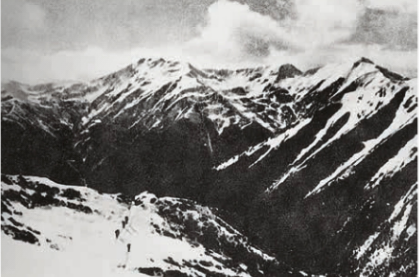
• Snow-capped Jiajin Mountains crossed by the Red Army during the Long March.
With the joining of two major forces, the concentration of Red Army troops in the area reached more than 100,000, greatly increasing the Red Army’s strength. On June 26, the Central Committee convened a meeting of the Political Bureau at Lianghekou, where Zhou Enlai suggested that the new base area should meet three conditions: 1) it should cover a wide area and allow for highly mobile operations; 2) it should have a large population and a fairly sound mass base; 3) it should have good economic conditions. Based on this, it was decided at the meeting that the Red Army should concentrate its main force to advance north in order to build a Sichuan-Shaanxi-Gansu revolutionary base area. Zhang Guotao, who led the Fourth Front Army, also expressed agreement with this plan. The Standing Committee of the Political Bureau of the CPC Central Committee then held a meeting, at which it decided to add Zhang Guotao to the Central Revolutionary Military Commission as vice chairman. Soon after, Zhang was also appointed as general political commissar of the Red Army. After this, however, Zhang changed his mind and called for the Red Army to retreat southward into Sichuan and Xikang, Casting a shadow over the prospects for the two armies after meeting up.
In early August, the first and fourth front red armies were reorganized into left and right columns for the march north. Mao Zedong, Zhang Wentian, and Zhou Enlai led the central government agencies and the Front Command in marching with the Right Route Army. The Left Route Army was under the leadership of Zhu De, Zhang Guotao, and Liu Bocheng, who led the Red Army General Headquarters. On August 21, the Right Route Army began to cross the grasslands in northern Sichuan. These vast swathes of uninhabited wilderness were littered with grassy swamps and stinking sludge pits, which were perilous enough to swallow up anyone who made even the slightest miscalculation. Cadres and soldiers marched long distances in an extremely weakened state and many perished on the march across. After seven days and nights, the Right Route Army at last emerged from the grasslands and settled down to wait for the arrival of the Left Route Army.
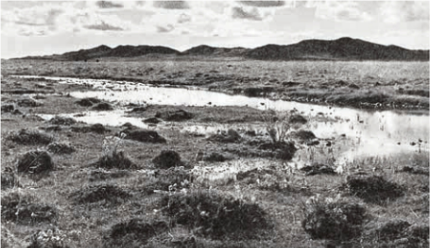
- The uninhabited grasslands crossed by the Red Army.
At this point, however, Zhang Guotao was inventing all manner of excuses to avoid marching north and insisted on the Right Route Army marching southward. On September 9, Zhang sent a telegram to Chen Changhao, the Right Route Army’s political commissar, and ordered him to lead the army south and “thoroughly carry out intraparty struggle.” When Ye Jianying, who was chief of staff of the Right Route Army, saw the telegram, he immediately reported it to Mao Zedong. Mao, Zhou Enlai, Zhang Wentian, Bo Gu, and Wang Jiaxiang held urgent discussions and decided to avoid internal conflicts in the Red Army and continue to march north, they should set out that night, leading the first and third armies 【The first, third, fifth, and ninth army groups of the First Front Army had become the first, third, fifth and 32nd armies.】 and a detachment of the Military Commission north. The Party Central Committee sent multiple telegrams to Zhang Guotao, demanding that he immediately lead his troops north and pointing out that, “If we go south, the enemy, terrain, residents, and supplies will be extremely unfavorable to us and will put the Red Army in an unprecedented plight.” Still, Zhang ignored. On September 12 at a place called Gojê (today Gaoji Village) in Têwo County, Gansu Province, the Political Bureau held an enlarged meeting at which judgment was passed on Zhang Guotao’s errors and the part of the Red Army that was marching north was renamed the Shaanxi-Gansu Detachment.
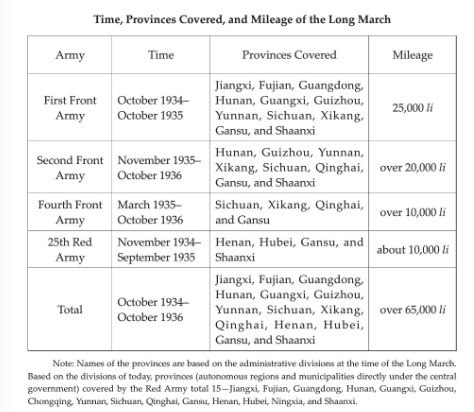
On September 17, the vanguard of the Shaanxi-Gansu Detachment reached Lazikou, a natural barrier of steep cliffs and overhanging rocks on the Sichuan-Gansu border and occupied the town of Hadapu the next day. Here Mao Zedong and others learned from a newspaper about a very large base area and Red Army contingent in northern Shaanxi. At the same time, the 25th Red Army, which had started the Long March from the Hubei-Henan-Anhui base in November 1934, arrived in the Shaanxi-Gansu base. It rendezvoused with the local 26th and 27th red armies. The three divisions were combined to form the 15th Red Army Group that broke through the encirclement and suppression of a large contingent of enemy forces. This created the conditions for the Party Central Committee to locate the headquarters of the Chinese revolution in the Northwest. On September 27, the Standing Committee of the Political Bureau held a meeting at Bangluo Town, at which it officially decided to press on to northern Shaanxi to defend and expand the base areas. On October 19, the Shaanxi-Gansu Detachment arrived at Wuqi Town in northern Shaanxi. At this point, having traveled 25,000 li across 11 provinces, the main force of the Central Red Army had victoriously completed its Long March.
The Shaanxi-Gansu base area was the only revolutionary base that was completely preserved in the latter stages of the Agrarian Revolutionary War. It provided a foothold for the Party Central Committee and red armies in the course of the Long March. It was also the starting point for the main force of the Eighth Route Army, formed by reorganizing the Red Army, when it marched to the frontline of the nationwide War of Resistance against Japanese Aggression. After arriving in northern Shaanxi, the Shaanxi-Gansu Detachment reverted to its original name of the First Front Red Army and incorporated the 15th Red Army Group into its ranks. From February to July 1936, the First Front Red Army embarked on eastern and western expeditions, which expanded the Shaanxi-Gansu grow into the Shaanxi-Gansu-Ningxia base.
On October 5, 1935, Zhang Guotao, who had insisted on moving south, openly established a separate “Central Committee” with himself as chairman. Zhu De and Liu Bocheng, who led the Left Route Army, conducted a resolute struggle against Zhang’s split with the Central Committee. On January 22, 1936, the Political Bureau of the Central Committee adopted the “Decision on Comrade Zhang Guotao’s Establishment of a Second ‘Central Committee,’” in which it instructed Zhang to immediately dissolve his “Central Committee.” Zhang’s attempt to split the Party failed to win support within the Fourth Front Red Army. Many cadres and soldiers demanded that the army march north to join the Central Committee and the First Front Army. After moving south, these troops suffered heavy casualties in battle. By April, merely over 40,000 men were left, about half the original number. During this time, the Central Committee sent one telegram after another urging the Fourth Front Army to head north. Zhang Hao (also known as Lin Yuying), who had returned from the Soviet Union, also sent a telegram to Zhang Guotao in the name of a member of the CPC’s delegation to the Communist International, asking him to dissolve his “Central Committee” immediately. At this point, Zhang Guotao was left with little choice but to announce the dissolution of his “Central Committee” on June 6, 1936.
In November 1935, the second and sixth red army groups led by Ren Bishi, He Long, and others, which had been active in the Hunan-Hubei-Sichuan-Guizhou base, also began marching northward from Sangzhi County in northwestern Hunan. After a great deal of hardship and peril, they finally joined up with the Fourth Front Red Army at Garzê in early July 1936. The Central Committee ordered the second and sixth army groups to combine with the 32nd Army to form the Second Front Army, with He Long as commander-in-chief and Ren Bishi as political commissar.
Thanks to Zhu De, Liu Bocheng, Ren Bishi, He Long, and others, and the support of many of the officers and soldiers of the Fourth Front Red Army, including Xu Xiangqian, the second and fourth front red armies finally marched north together. On October 9, the staff of the Fourth Front Red Army headquarters reached Huining County in Gansu to join forces with the First Front Red Army. On October 22, the staff of the Second Front Red Army headquarters arrived at Jiangtaibu, Longde, Gansu Province (part of Xiji of the Ningxia Hui Autonomous Region today), where it, too, joined up with the First Front Red Army. At this point, the second and fourth front red armies completed the Long March.
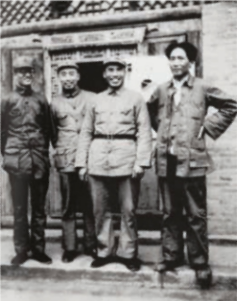
- Mao Zedong, Zhu De, Zhou Enlai, and Bo Gu arrive in northern Shaanxi after the Long March
The triumph of the Long March of the Workers’ and Peasants’ Red Army was the turning point for the Chinese revolution. Mao Zedong once vividly described the Long March as “the first of its kind in the annals of history… a manifesto, a propaganda force, a seeding-machine.” It proclaimed the failure of the KMT’s encirclement, pursuit, obstruction, and interception efforts and the success of the Red Army’s strategic shift, disseminated the political ideas of the CPC, sowed the seeds for the Chinese revolution along the way, and strengthened the confidence of the people. The strategic shift made by the Red Army in the Long March was accomplished under the leadership of the new CPC Central Committee established at the Zunyi Meeting with Mao Zedong at the core. The victory showed that the CPC and the Chinese Workers’ and Peasants’ Red Army were an invincible force that had the tremendous vitality to overcome all difficulties. Though small in number, the survivors of the Long March were the essence of the Party and would become the core force leading the War of Resistance against Japanese Aggression and the People’s War of Liberation in the future. Mao Zedong once stated, “Our military force had reached 300,000 before the Long March, but due to the errors some leaders made, it was reduced to less than 30,000, one tenth of the original number. What really matters is that we do not waver when things get tough. 30,000 or 300,000, which is stronger? An army of less than 30,000 men, if well experienced, might be stronger than that of 300,000.”【Mao Zedong, ”Imperialism Is Informidable”(May 7,1960,Collected Works of Mao Zedong,Chin. ed.,People’s Publishing House, 1999,Vol,VIII,p,174】
Routes of the Long March of the Chinese Workers' and Peasants' Red Army(1934.10-1936.10)
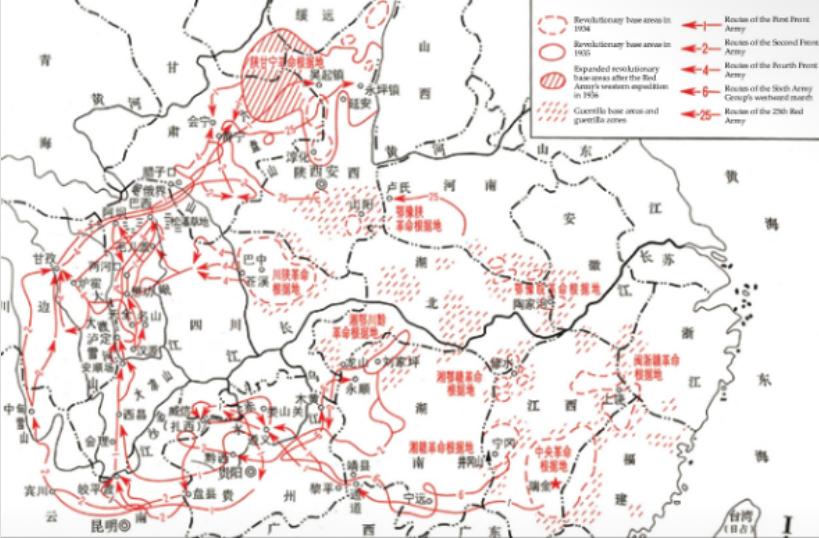
The Long March of the Chinese Workers’ and Peasants’ Red Army was a tremendous expedition driven by ideals and beliefs. It was an immense test of truth, which would awaken the people and write a new chapter in Chinese history.
Revolutionary ideals can soar beyond the skies. The hardships, twists and turns, and deaths on the Long March put the ideals and beliefs of Chinese Communists to the ultimate test and proved to the world that their convictions were not to be broken. The heroic soldiers of the Red Army fought more than 600 battles. They crossed almost 100 rivers, scaled 40-plus mountains and dangerous peaks—20 of which were covered in snow and lay over 4,000 meters above sea level—and traversed a veritable death trap in the vast grasslands of southern Sichuan. While crossing the snowy mountains, one commander encountered a Red Army soldier frozen to death in thin and tattered clothing. The commander called for the quartermaster for an explanation. A tearful solider explained to the commander that the frozen man was none other than the quartermaster; he had sacrificed himself to give clothing to his comrades. It was this sort of high-mindedness that enabled the Red Army to overcome unprecedented difficulties, challenge the limits of human endeavor, and write a truly miraculous epic.
Adversity breeds success. The victory of the Long March was a great contributor to the political and theoretical maturity of the Party. The Party was now clearer than ever that victory in the Chinese revolution could only be won by integrating the basic tenets of Marxism with the concrete realities of the Chinese revolution and by solving the major problems of the Chinese revolution independently. This lesson had been learned through sacrifice and struggle. Having been thoroughly tempered along the Long March, the Party continued to evolve theoretically and realized an unprecedented degree of unity within the Party in the pursuit of truth.
The victory of the Long March fully demonstrated the powerful nature and purpose of the CPC. It buttressed the Party’s beliefs, sowed the seeds of revolution, and expanded the influence of the Party and the Red Army. As the Red Army’s main forces were undertaking the Long March, Red Army and guerilla units that remained in base areas endured firm revolutionary ideals and beliefs. It is defined by the firm belief that the just cause will triumph and by the courage to fear no difficulty or sacrifice when it comes to saving the country and its people. It is defined by independence and initiative, seeking truth from facts, and proceeding from practice. It is about taking the interests of the whole nation into account, remaining disciplined, and working closely together. It is about standing with the people through weal and woe and struggling tenaciously alongside them. The spirit of the Long March is a vivid reflection of the demeanor of Chinese Communists and the people’s army under their leadership; it is a demonstration of the Chinese people’s spirit of constant self-improvement; it is the highest embodiment of a national spirit based on patriotism. It became an inspirational force that helped push the Chinese revolution from one victory to another.
Late in October 1936, in order to open up a route to access assistance from the Soviet Union, a part of the Fourth Front Red Army received instructions from the Central Revolutionary Military Commission to cross the Yellow River to the west and prepare for a campaign in Ningxia. On November 11, in accordance with a Central Committee decision on the matter, the troops crossing the river were renamed the West Route Army. In extremely difficult conditions, the troops ventured deep into the Hexi Corridor and engaged in four months of fighting. They eliminated more than 20,000 enemy troops before they were greatly outnumbered and defeated in the Qilian Mountains in March 1937. The heroism of the West Route Army, which braved hardships and bloodshed, and its spirit of heroic sacrifice for the Party and the people was akin to the Long March Spirit. Such heroism is an important part of the revolutionary heritage of the Chinese Communists and a precious asset of the Chinese nation.
source from: 100 Years of the Communist Party of China