
The Zunyi Meeting and the Red Army’s Completion of the Long March
2026-10-17 13:14:37
The disastrous effects caused by “Left” dogmatism after the enlarged Fourth Plenary Session of the Sixth Central Committee sent the Chinese revolution into yet another low ebb, and the CPC once again suffered a grave failure. It was under these circumstances that the Party Central Committee convened the Zunyi Meeting, where it established a new and correct leadership. Without fear of difficulties, the CPC led the main forces of the Red Army in overcoming all hurdles and marching tens of thousands of miles to successfully complete a strategic shift. The Party had survived its toughest period and blazed a new trail for the Chinese revolution.
-The Zunyi Meeting: A Great Historic Turning Point
As the Central Red Army set out on the Long March, the leaders of the CPC Central Committee compounded their “Left” errors with the further mistake of allowing troops to flee in disorder and trying to take everything with them. Carrying cumbersome gear, an entire force of over 80,000 trekked through mountains along winding trails so narrow that often they could file through only a single pass over one night.
According to the original plan, the Central Red Army would march to northwestern Hunan and there rendezvous with the second and sixth red army groups. The KMT authorities deployed four blockade lines along the Red Army’s westward route. Red Army troops paid a heavy price in breaking through the fourth blockade at the Xiang River, under attack from the KMT Hunan Army and the Guangxi Army. On December 1, 1934, the CPC Central Committee and the Central Revolutionary Military Commission and its subordinate agencies crossed the river. Implementing the task of stalling the pursuing enemy, Chen Shuxiang, commander of the 34th Division, was captured. He twisted his own intestines and died a hero’s death. It was said that during the battle “every inch of land was soaked in the blood of soldiers and every step laid the bodies of heroes.” After eventually crossing the Xiang River, the Central Red Army was reduced to just over 30,000 troops from more than 86,000 at the outset of the Long March.
Party members and Red Army troops began to have a rising sense of distrust and dissatisfaction with the wrong leadership and require for the change of leaders. In light of the harsh reality, some leaders who had initially supported the mistaken “Left” line also gradually changed their attitude.
After the Xiang River Battle, a heated debate broke out over the Central Red Army’s next steps. After occupying the county of Tongdao, Hunan Province, the troops entered Guizhou. On December 18, 1934, the Political Bureau of the CPC Central Committee held a meeting in Liping, Guizhou Province. At the suggestion of Mao Zedong, the meeting adopted a resolution to abandon the original plan to rendezvous with the second and sixth army groups in northwest Hunan Province and instead march to northern Guizhou. On January 7, 1935, the Red Army captured Zunyi, a town of strategic importance in northern Guizhou.
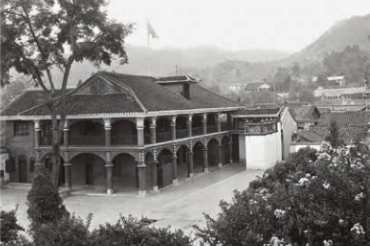
Site of the Zunyi Meeting
From January 15 to 17 the CPC Central Committee held an enlarged meeting of the Political Bureau in Zunyi, historically known as the Zunyi Meeting. The meeting focused on rectifying the “Left” errors in military and organizational matters of decisive importance. Zhang Wentian, Mao Zedong, and Wang Jiaxiang sharply criticized two mistakes made by Bo Gu and Braun—the purely defensive action undertaken during the fifth campaign against the enemy’s encirclement and suppression and fleeing during the Long March. Most attendees agreed with the opinions of Zhang, Mao, and others. The Political Bureau elected Mao Zedong to its Standing Committee and assigned Zhang Wentian to draft a resolution evaluating the fifth campaign against encirclement and suppression for the Central Committee. Not long after this meeting, during a march to the Zhaxi region, Yunnan Province, the Standing Committee arranged for Zhang Wentian to replace Bo Gu as the head of the Party. The Political Bureau adopted the resolution of the Zunyi Meeting and promptly transmitted and implemented it throughout the army. In mid-March, it set up a three-member group¹【 ¹While preparing for the Long March of the Central Red Army’s main forces, the CPC Central Committee had in the summer of 1934 also set up a three-member group consisting of Bo Gu, Li De, and Zhou Enlai.】 composed of Mao Zedong, Zhou Enlai, and Wang Jiaxiang to take command of all the Red Army’s military operations.
The Zunyi Meeting was a pivotal moment in the Party’s history. Held at a historical juncture following the Red Army’s defeat in its fifth campaign against the KMT’s encirclement and suppression, and in the wake of the serious setbacks in the early period of the Long March, the meeting de facto established Mao Zedong as leader of the CPC Central Committee and the Red Army. It also opened the way for the correct Marxist line adopted by the CPC Central Committee with Mao Zedong as its main representative, as the first generation of central collective leadership with Mao at its core was beginning to take shape. The meeting set the stage for the Party to independently solve the practical problems of the Chinese revolution and saved the Party, the Red Army, and the Chinese revolution at the most precarious moment. After this, it enabled the CPC to triumph over Zhang Guotao’s splittism and complete the Long March, ushering in a new phase in the Chinese revolution. The meeting was defined by its determination to champion the truth, correct mistakes, and establish the right leadership of the Party Central Committee. It allowed for the creative formulation and implementation of strategies and policies that were in line with the characteristics of the Chinese revolution.
After the Zunyi Meeting, under the command of Mao Zedong, the Central Red Army became more agile, altering the direction of battle as the situation changed, turning first east, then west, and outflanking the large enemy divisions. It confused the enemy and wore it out by keeping it on the move and taking the initiative everywhere it went. From late January to late March 1935, the Red Army crossed the Chishui River four times. Late in March, it crossed the Wujiang River in the south to feign an attack on Guiyang. Surprised by the action, Chiang Kai-shek, who was overseeing operations at Guiyang, hurriedly brought his Yunnan troops up as reinforcements. In response, the Red Army immediately launched a long-range raid on Yunnan, its vanguard troops pressing on the provincial capital, Kunming. With Kunming only lightly defended, reinforcements had to be hastily called in from among the forces defending the Jinsha River, and defense there was seriously weakened as a result. The Red Army then suddenly swung around and dashed northward. By early May, the entire force had made it across the Jinsha River.
The Central Red Army had seen off attempts by hundreds of thousands of KMT troops to encircle, pursue, obstruct, and intercept it, foiled Chiang Kai-shek’s plan to surround and eliminate it on the border of Sichuan, Guizhou and Yunnan, and achieved a decisive victory in its strategic shift. This victory, made possible by changes in the central military leadership, was a testament to superb military command skills of Mao Zedong.
source from:100 Years of the Communist Party of China