
Red Army Guerrilla Warfare in the South and the Struggle of the Northeast United Resistance Army
2026-10-20 17:33:52
From the second half of 1934 onward, after the series of strategic shifts carried out by the main forces of the Red Army, to the eruption of the nationwide War of Resistance against Japanese Aggression in 1937, the Red Army and guerrilla forces that were left behind on both sides of the Yangtze River engaged in arduous struggles under the leadership of the Party and with the support of the people.
In October 1934, when the main forces of the Central Red Army were withdrawing from the bases, the CPC Central Committee decided to set up the Central Sub-Bureau of the Soviet Area and the Central Military District, with Xiang Ying as sub-bureau secretary, military district commander and political commissar. At the same time, it set up the Central Government Office of the Chinese Soviet Republic with Chen Yi as its director. The military units that remained in the bases were the 24th Red Division, independent regiments, and local guerrillas, totaling over 16,000 men.
After concealing the strategic shift of the Red Army’s main forces, under the leadership of Xiang Ying and Chen Yi, the military units which remained in the base areas broke through the encirclement in small groups and began a campaign of guerrilla warfare. Vastly outnumbered, heavy losses were sustained.
Red Army Activities in Guerrilla Base Areas in Eight Southern Provinces
(Autumn 1934–Autumn 1937)
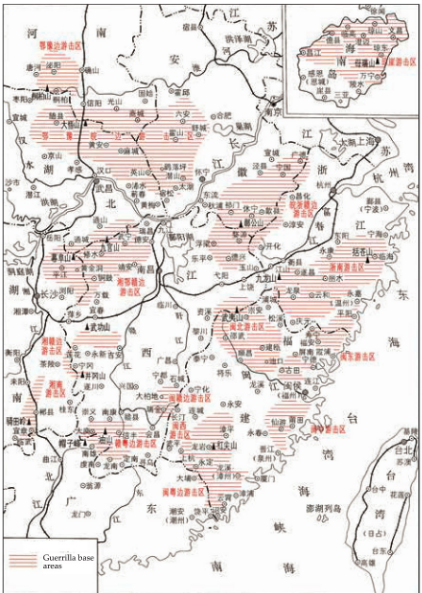
At the end of March 1935, Xiang Ying, Chen Yi, and others led a detachment of around 300 to the Jiangxi-Guangdong border area. There, they met with local Party organizations and guerrilla forces and waged an arduous grueling guerrilla war centered around the town of Youshan. The Central Sub-Bureau also sent Lai Changzuo to Ruijin to serve as secretary of the CPC Special Committee and lead the guerrilla war in the Fujian-Jiangxi border area and sent Chen Tanqiu, Deng Zihui, and Tan Zhenlin to western Fujian to join forces with the troops of Zhang Dingcheng and carry on the struggle.
At the same time, Party organizations and Red Army guerrilla forces relied on the support of the people to carry out unrelenting and heroic guerrilla assaults in northern, eastern, and central Fujian and on the Fujian-Guangdong border area, the Anhui-Zhejiang-Jiangxi region, southern Zhejiang, southern Hunan, the Hunan-Hubei-Jiangxi region, the Hunan-Jiangxi region, the Hubei-Henan-Anhui border area, the Hubei-Henan border area, and the Qiongya region.
In response to the continual military “pacification” and tight economic blockades of the KMT authorities, the Red Army and guerrilla forces in the southern guerrilla zones deployed guerrilla warfare and other struggle tactics in a smart and flexible way to contend with the enemy. They frequently disappeared into high mountains and dense forests, hid by day and operated at night, stood exposure, deprivation and hunger, and suffered untold hardships. Xiang Ying, Chen Yi, and others were once besieged at Meiling at the border of Jiangxi and Guangdong provinces for days, facing the danger of death every minute. At this moment, Chen wrote a touching poem:
“What if my head falls today?
Revolution is hard; it takes a hundred battles.
I shall rally my comrades of old in the netherworld,
A mighty host to wipe out the King of Hell.”
The poem expressed his infinite loyalty to the Party and the people and his noble sentiment of being ready to die for the revolution. A resolution adopted at a meeting of the Political Bureau of the CPC Central Committee on December 13, 1937 highly praised the three-year guerrilla war of the southern Red Army and guerrilla forces. After the nationwide War of Resistance against Japanese Aggression broke out, the Red Army and guerrilla forces that remained in the eight southern provinces (not including the Qiongya Red Army, which was reorganized into part of the Guangdong People’s Counter-Japanese Self-Defense Corps to resist the Japanese invaders in Hainan Island) were reorganized into the New Fourth Army, which became a major armed force on the resistance front on both sides of the Yangtze River.
During the three-year guerrilla war of the Red Army in the South, so many lives were heroically lost in battle, including those of high-ranking cadres who had stayed behind to carry on the struggle, such as He Shuheng, He Chang, Mao Zetan, Wan Yongcheng, Gu Bai, and Ruan Xiaoxian, as well as many Red Army officers and soldiers. After Qu Qiubai and Liu Bojian were captured, they remained faithful and unyielding and sacrificed their lives for the cause, reflecting the strong sense of dedication and nobility of Chinese Communists.
After the September 18th Incident of 1931, the CPC actively organized and led the fight against Japanese aggression in China’s three northeastern provinces. On January 26, 1933, the CPC Central Committee issued a “Letter to CPC Organizations at All Levels and to All CPC Members in Manchuria,” which proposed for the first time a strategy for organizing a Chinese united front for resistance in the Northeast. Following the instructions of the letter, the CPC Manchuria Provincial Committee decided to expand the CPC-led counter-Japanese guerrilla forces, implement the policy of a Chinese revolutionary united front, reject close-doorism, and improve the relations between the CPC-led counter-Japanese guerrilla forces and other counter-Japanese forces. From September 1933, the CPC Manchuria Provincial Committee reorganized the guerrilla resistance forces into the Northeast People’s Revolutionary Army.
In February 1936, the CPC delegation to the Communist International, which directly presided over the Party organizations in the Northeast, decided to unify all resistance forces in the Northeast so as to form the Northeast United Resistance Army and establish the Northeast United Resistance Army General Headquarters. The Declaration of the Northeast United Resistance Army’s Organizational Structure was then published in the name of Yang Jingyu, Wang Detai, Zhao Shangzhi, and Zhou Baozhong, announcing that the Northeast People’s Revolutionary Army and the various counter-Japanese guerrilla forces in the Northeast were to be incorporated into the Northeast United Resistance Army.
The Northeast United Resistance Army opened up three guerrilla zones in southeastern Manchuria, northern Manchuria, and Jidong. The first and second armies operated in southeastern Manchuria. These two armies were merged in July 1936 to form the First Route Army of the Northeast United Resistance Army with Yang Jingyu as commander-in-chief and Wang Detai as deputy commander-in-chief. The third, fourth, and sixth armies operated in northern Manchuria. And the main forces of the Fifth Army operated in Jidong. In November 1936, the Seventh Army of the Northeast United Resistance Army was formed from the Second Division of the Fourth Army.
Besides the above-mentioned seven armies of the Northeast United Resistance Army, which came directly under the leadership of the CPC, the Eighth, Ninth, Tenth and 11th armies had been established by 1937, around the time when the nationwide War of Resistance against Japanese Aggression broke out.

• Yang Jingyu
The Northeast United Resistance Army developed into 11 divisions comprising more than 30,000 troops. These forces carried out guerrilla warfares in a vast region bordered to the south by the Changbai Mountains, to the north by the Xiao Hinggan Range, by the Wusuli River in the east, and the east bank of the Liao River in the west. The thousands of large and small operations against Japanese aggression and collaborationist troops crushed the enemy’s punitive campaigns on multiple occasions. These heroic struggles delivered a powerful blow to Japanese colonial rule in northeast China, pinned down a large number of Japanese troops, and supported and encouraged the nationwide movement to resist Japanese aggression and save the nation.
source from: 100 Years of the Communist Party of China