
No.3 2026
CONTENTS
The Fundamental Principle for Understanding What Good Performance Means and Acting Accordingly: An In-Depth Study of General Secretary Xi Jinping’s Major Expositions on Understanding What Good Performance Means and Acting Accordingly // Feng Jun
Special Feature: The Tenth Anniversary of General Secretary Xi Jinping’s Major
Speech Delivered on May 17
The Triple Connotations and Historical Mission of Philosophy and Social Sciences with
Chinese Characteristics //Fan Xichun
The Guiding Thought for Advancing Philosophy and Social Sciences with Chinese Characteristics in the New Era //Zhang Guozuo
Research on the Chinese Compilation and Translation of Classical Marxist Works The Chinese Compilation, Translation, and Publication of The Chronicle of Lenin //Peng Xiaoyu & Hou Jingna
Research on Fundamental Marxist Theories
A Reconsideration of the Consistency of Marx and Engels’ Philosophical Thought //An Qinian
The Internal Logic of Improving the Socialist Financial Strength of China in the Evolution of Legal Rights // Song Chaolong & Bai Yuqiao
An Ethical Examination of the Paradigm of the Good Life: Marx and Aristotle // Li Changcheng
Two Paths beyond Modernity: Marx and Strauss //Hao Zhichang & Liu Xiaona
“Reversal” or “Reconstruction”? A Reexamination of the Young Marx’s Concept of “Inversion” //Zhou Zhizhen
The Temporal Determination in Marx’s Value Theory //Pan Yuwen
Research on Political Economy with Chinese Characteristics
The Generative Logic, Core Essence, and Practical Orientation of Xi Jinping’s Major Expositions on Consumption // Ding Renzhong & Guo Yimeng
The Deep Integration of the Real Economy and the Digital Economy: Institutional Mechanisms and Developmental Prospects //Lu Yang
Theoretical Interpretation, Obstacles, and Implementation Paths for Further Developing a Unified National Market //Mao Qiang & Pang Kai
Research on the History of the Development of Marxism
The Exploration of the Communist Party of China in Upholding Cultural Leadership since the Inception of Reform and Opening up // Yang Fengcheng & Zhang Zhiqiang
The Wisdom of Mao Zedong’s Struggle and Its Contemporary Value //Chen Long
Research on Political Communication
An Examination of the Practical Dimension of Political Communication Courses in Schools in the New Era // Xu Yanguo
The Theory and Path for the Integrated Development of Political Communication Curricula across All Educational Levels in the New Era //Liu Hongsen
Research on Contemporary Capitalism
A Three-Dimensional Critique of Climate Capitalist Hegemony //He Wei & Cheng Yichun
The Alienation of Cultural Life in Digital Capitalism and Its Resolution //Li Mengyun & Li Mengxi
Neurocapitalism: A New Trend in Capitalist Development in the Digital Age //Yang Yongqiang
Research on Marxism Abroad
Characteristics, Manifestations, and Crises of Neo-Imperialism //Feng Yanli
On the Logical Evolution of Lukács’s Ethical Thought //Yan Yan & Liu Danfei
The Implications of Capital Power in Foucault’s Theory of Power: Reflections from
the Perspective of Althusser //Dong Jianming
Academic Developments
A Review of Domestic Academic Research on Marxist Theories Abroad in 2025 //Project Team of the Fourth Research Department of the Institute of Party History and Literature of the CPC Central Committee
Several Discussions by French Left-Wing Scholars on the Issue of Reproduction in Recent Years //Zhang Chunying
MAIN ABSTRACTS
The Fundamental Principle for Understanding What Good Performance Means and Acting Accordingly: An In-Depth Study of General Secretary Xi Jinping’s Major Expositions on Understanding What Good Performance Means and Acting Accordingly
Feng Jun
Since the 18th National Congress of the Communist Party of China, General Secretary Xi Jinping has delivered a series of major statements on understanding what good performance means and acting accordingly, profoundly elucidating such major questions as “for whom good performance is pursued,” “what kind of good performance should be pursued,” and “by what means good performance should be attained.” These expositions provide fundamental guidance for Party members and officials in understanding what good performance means and acting accordingly. The issue of good performance is a fundamental one, bearing directly upon the Party’s commitment to serving the public interest and governing for the people. Understanding what good performance means and acting accordingly embody political integrity, the proper way of governance, and the essential principle of administration. "For whom good performance is pursued" concerns value orientation and addresses the question of for whose benefit achievements are created; bringing benefits to the people constitutes the greatest performance. “What kind of good performance should be pursued” concerns goal orientation and answers the question of what constitutes understanding what good performance means and acting accordingly, with high-quality development representing an important dimension thereof. “By what means good performance should be attained” concerns the practical path and addresses the question of how genuine performance is realized, emphasizing that performance must be achieved through solid and diligent work and must withstand the tests of practice, the people, and history. These expositions provide a profound interpretation of the overall requirements for education on understanding what good performance means and acting accordingly, namely, serving the public interest, seeking the wellbeing of the people, making sound and rational decisions, and working earnestly and pragmatically.
The Triple Connotations and Historical Mission of Philosophy
and Social Sciences with Chinese Characteristics
Fan Xichun
Philosophy and social sciences with Chinese characteristics constitute a modern scientific system formed through integrating the fundamental tenets of Marxism with China’s concrete realities and with the best elements of China’s traditional culture. As a modern scientific system distinguished by strong continuity and national characteristics, they represent a unique emblem of the cultural spirit of the Chinese nation. Owing to their systematic and specialized character, philosophy and social sciences with Chinese characteristics play an important guiding role in thought throughout the historical process of advancing and expanding Chinese modernization and serve as a major transformative force in promoting China’s economic and social development. By virtue of their originality and contemporary relevance, they enrich, develop, and consolidate the cultural subjectivity of the Chinese nation and constitute an organic component of a new cultural form of life. As a comprehensive modern scientific system encompassing all dimensions, fields, and elements, philosophy and social sciences with Chinese characteristics undertake, at a new historical starting point, the mission of advancing national rejuvenation and the building of a great modern socialist country.
A Reconsideration of the Consistency of Marx and Engels’ Philosophical Thought
An Qinian
The theory of the “opposition between Marx and Engels’s philosophical thought” maintains that Marx’s philosophy proceeded from practice and emphasized human subjectivity, whereas Engels established dialectical materialism, which explained the world through matter and its dialectical movement, and that the two approaches were fundamentally opposed. This erroneous view is inconsistent with historical facts and also reflects a misunderstanding of Marx. In reality, Marx understood the world simultaneously from the perspectives of matter and its movement and of human practical activity; practical activity itself is a form of interaction among material entities. Marx’s emphasis on practice was intended to explain how the human environment changes and how human development may be understood through transformations in that environment, thereby seeking a path toward human emancipation, rather than opposing material ontology.
The Generative Logic, Core Essence, and Practical Orientation
of Xi Jinping’s Major Expositions on Consumption
Ding Renzhong & Guo Yimeng
Xi Jinping’s major expositions on consumption systematically address the major challenges posed by the transformation of China’s stage of economic development to both consumption theory and practice. Grounded in an integrated understanding of the functional attributes of consumption and governance policy, these expositions may be examined from three dimensions: their generative logic, core essence, and practical orientation. They inherit, innovate upon, and further develop Marxist theories of consumption, carry forward and elevate the Communist Party of China’s historical explorations concerning consumption, and accord with the practical requirements of China’s economic structural transformation and the advancement of Chinese modernization in the New Era. Centering on the structural role of consumption in the New Era, these expositions identify consumption as a fundamental driving force, emphasize its function as a key link in economic circulation, guide new trends in consumption upgrading through structural transformation, interpret common prosperity as the value orientation of consumption, and shape a sustainable consumption paradigm through a green orientation, thereby constructing a logically rigorous and systematically integrated theoretical framework. By improving long-term consumption mechanisms, promoting innovation in consumption scenarios, and optimizing the supply structure, the transformation of the consumption governance system from short-term stimulus toward structural restructuring and institutional reform can be facilitated. Xi Jinping’s major expositions on consumption not only embody a systematic understanding of the laws governing the operation of the consumption economy, but also provide theoretical support and institutional guidance for advancing the development of a modern consumption system with Chinese characteristics.
The Exploration of the Communist Party of China in Upholding Cultural Leadership
since the Inception of Reform and Opening up
Yang Fengcheng & Zhang Zhiqiang
Since the inception of reform and opening up, the Communist Party of China has continuously enriched and developed its exploration of cultural leadership. In the initial stage of reform and opening up, the Party focused on rectifying theoretical confusion, reaffirmed the Four Cardinal Principles, and advanced the general task of building socialist cultural-ethical progress. During the establishment of the socialist market economy and the expansion of all-round opening up, while upholding Marxism as the guiding ideology and safeguarding the socialist ideological sphere, the Party actively explored ways to guide the development of contemporary Chinese culture by promoting the creation of more outstanding socialist cultural works and striving to foster a cultural development pattern characterized by “one guiding principle alongside diversity.” Since entering the New Era, the Party Central Committee with General Secretary Xi Jinping at its core has not only explicitly advanced the major proposition of “the CPC’s cultural leadership,” but has also put forward a series of new concepts, ideas, and propositions concerning such issues as upholding the fundamental system of Marxism’s guiding position in the theoretical sphere, developing a socialist thought with strong cohesion and leadership, cultivating and practicing the core socialist values, and maintaining leadership in news media and public opinion work in the context of information technology. In doing so, the Party has formed a more systematic and mature theory of cultural leadership.
A Three-Dimensional Critique of Climate Capitalist Hegemony
He Wei & Cheng Yichun
Under the pretext of “addressing the climate crisis,” climate capitalism engages globally in economic exploitation, political oppression, and technological blockade, the essence of which is hegemonism. In the economic sphere, climate capitalism relies on market fundamentalism and employs carbon markets as a vehicle for pursuing new forms of surplus value, thereby driving a new “shift in power.” In the political sphere, it reveals the class nature and exclusiveness of ecological imperialism by artificially constructing a global “carbon divide.” In the sphere of science and technology, climate capitalism erects “small yard, high fence” barriers and imposes technological blockades to suppress the technological development of developing countries, thereby preserving its hegemonic position. In essence, climate capitalism seeks to sustain capitalism and its global dominance through the “climate card,” a strategy that is neither just nor sustainable. Only by exposing the hegemonic essence, ideological mystification, and deceptive nature of climate capitalism, while exploring just, effective, and feasible responses to ecological degradation and climate deterioration, can humanity advance along the path toward global ecological civilization and realize harmony between humanity and nature.
英文目录和摘要审校 童孝华
No. 3 2026
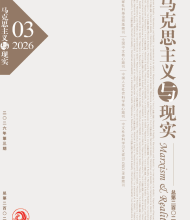
- No. 3 2026
- No. 2 2026
- No. 1 2026
- No. 6 2025
- No. 5 2025
- No. 4 2025
- No. 3 2025
- No. 2 2025
- No. 1 2025
- No. 6 2024
- No. 5 2024
- No. 4 2024
- No. 3 2024
- No. 2 2024
- No. 1 2024
- No. 6 2023
- No. 5 2023
- No. 4 2023
- No. 3 2023
- No. 2 2023
- No. 1 2023
- No. 6 2022
- No. 5 2022
- No. 4 2022
- No. 3 2022
- No. 2 2022
- No. 1 2022
- No. 6 2021
- No. 5 2021
- No. 4 2021