
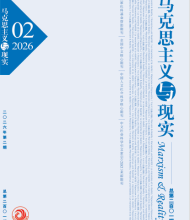
No.2 2026
CONTENTS
Contributing to the Adaptation of Marxism to the Chinese Context and the Needs of Our Times Through Translation and Compilation: A Discussion Based on the Publication of the Oral History of the Compilation and Translation of Classical Marxist Works Series // Wei Haisheng & Fang Wenhao
Three Qualitative Dimensions of the Cultural Form of Chinese Modernization //Shen Jiangping
Approaches to Deepening Understanding of the CPC as a Faithful Inheritor and Promoter of the Best of Traditional Chinese Culture // Fan Xianlei
The Significance and World-Historical Implications of Exchanges and Mutual Learning Among Civilizations // Lai Qingli
Engels’s Revisions of Key Conceptual Terms in the Main Manuscripts of Volume III of Marx’s Capital
Marx’s Methodology in Constructing the Theoretical System of Political Economy and Its Adaptation to the Chinese Context and the Needs of the Times // Huang Taiyan & Du Xiangrui(42)
From Machine Labor to Intelligent Labor: New Developments in Marx’s Theory of the Labor Process // Xiao Feng
On the Connotations and Essence of Marx's Theory of Historical Necessity // Hong Guangdong & Zhang Lei
The Political-Economy Foundations of Deep Integration Between Science and Technology // and the Economy: Rereading Lenin’s The Agrarian Question and the “Critics of Marx” //Zhang Xinning
The Dialectical Deduction of Marx’s Concept of Alienation and the Upward Transformations of the Logic of Thought //Ma Mingchong
From Discovering Society to Reconstructing Society: Adam Smith, Hegel, and Marx //Cheng Han
Development Planning: A Key Instrument of National Economic Governance //Ge Yang
Expanding International Economic Flows to Promote the Creation of a New Development Pattern // Xie Shenxiang & Li Tong
The First-Level Discipline of CPC History and Party Building Studies as Disciplinary Support for the Development of the Political Communication Course in the New Era //Qi Pengfei
Characteristics of Online Public Opinion and Strategies for Guidance in the All-Media Era //Gao Fei
Special Topic: Studies on Issues Related to Artificial Intelligence
How Has Artificial Intelligence Achieved Leapfrogging Advances? //Wu Zhongmin
Artificial Intelligence and the Well-Rounded Development of Individuals: A Historical Materialist Perspective // Yao Xiujie
Behavioral Characteristics, Ideational Foundations, and the Generative Logic of Hegemonic Techno-Nationalism: A U.S.-Centered Examination // Liu Yang
The Hegemonic Logic of Techno-Orientalism and a Critique of Its Essence //Shi Lichun
A Critique of the Theory and Practice of Techno-Colonialism // Wu Xin
Reconstructing Karl Marx’s Original Thought: Henri Lefebvre’s Contemporary Interpretation of Marxism // Zhang Xiaoyi
Fraser’s Expansion of the Concept of Capitalism and Its Problems //Xie Yongkang & Li Mengrui
Two Paradigms in Contemporary Western Marxist Interpretations of Marx’s Teleology and Their Significance // Jiang Haoliang
A Review of Research on Marxist Theory in Chinese Academia in 2025 //Research Group, Fourth Research Department, Institute of Party History and Literature of the CPC Central Committee(190)
MAIN ABSTRACTS
Three Qualitative Dimensions of the Cultural Form of Chinese Modernization
Shen Jiangping
Rooted in China’s modernization and forged through the Two Integrations, the cultural form of Chinese modernization rests on solid theoretical foundations while exhibiting a rich, multilayered structure. It functions both as an objective orientation and as a key vehicle for advancing the development of a strong socialist culture in China. Internally, this cultural form comprises distinct yet interlocking levels that are mutually reinforcing and logically coherent. Xi Jinping Thought on Socialism with Chinese Characteristics for a New Era constitutes its concentrated embodiment and provides an overarching logical framework. Xi Jinping Thought on Culture represents its theoretical synthesis and plays a foundational role in structuring its core architecture. Meanwhile, the distinctive worldview and the perspectives on values, history, civilization, democracy, and ecology embedded in Chinese modernization articulate its essential substance in a highly refined and systematized philosophical form. Among these elements, Xi Jinping Thought on Culture serves as a crucial bridge linking Xi Jinping Thought on Socialism with Chinese Characteristics for a New Era and the distinctive “six perspectives.” Together, these three components are indispensable and constitute the three qualitative dimensions of the cultural form of Chinese modernization. Analyzing this cultural form across these three levels provides a fundamental approach to grasping its structural richness in a comprehensive and in-depth manner.
The Significance and World-Historical Implications of
Exchanges and Mutual Learning Among Civilizations
Lai Qingli
Profound changes unseen in a century are accelerating across the world, while the modern civilizational paradigm dominated by capitalism is increasingly beset by crises and deadlocks. This context calls for discourses, concepts, and normative orders that genuinely correspond to the needs of human civilizational development and progress. Marx and Engels profoundly revealed the social roots of phenomena that impede such progress and pointed to the historical necessity of exchanges and mutual learning among civilizations. Building on this theme, Xi Jinping has advanced a series of new ideas, viewpoints, and conclusions. Deepening understanding of his important statements-from the perspectives of its essence, principles, carriers, and objectives-and clarifying its world-historical significance will help promote forms of civilizational interaction that better accord with universal principles, meet the developmental needs of civilizations on the basis of shared interests, and facilitate the construction of a civilizational order more conducive to common progress.
Marx’s Methodology in Constructing the Theoretical System of Political Economy and Its Adaptation to the Chinese Context and the Needs of the Times
Huang Taiyan & Du Xiangrui
Building an autonomous knowledge system of Chinese economics requires a scientific methodology. Accordingly, a systematic examination of Marx’s methodology in constructing the theoretical system of political economy-and of its adaptation to the Chinese context and the needs of the times-is of central importance. Marx’s methodology features the unity of the method of inquiry and the method of exposition, grounded in dialectical and historical materialism. His inquiry proceeds through scientific abstraction: on the basis of ample typical materials, theoretical thinking abstracts generally applicable concepts to reveal internal connections and laws, with the depth of inquiry shaped by the level of theoretical thinking. His exposition begins with abstract general concepts, moves from the abstract to the concrete, and presents the political-economy system in an ideational form. The inquiry process provides the foundation for constructing the theoretical system, while exposition is its concrete manifestation in thought; the construction of the system is essentially an organic unity of the two. Drawing on China’s practical innovations, the Party has advanced the adaptation of Marx’s methodological approach to the Chinese context and the needs of the times, creatively proposing the worldview and methodology of socialism with Chinese characteristics for a new era as the fundamental method for developing an autonomous knowledge system of Chinese economics. It further emphasizes extracting and refining new patterns and emblematic concepts from China’s development experience and elevating them into a systematic economic theory-thereby integrating research and narrative methods grounded in China’s typical development experience to support the construction of an autonomous knowledge system of Chinese economics.
From Machine Labor to Intelligent Labor: New Developments
in Marx’s Theory of the Labor Process
Xiao Feng
The theory of the labor process-addressing the question of “how to work”-is an important component of Marx’s view of labor. It underscores the decisive role of labor tools, as elements of the productive forces, in transforming labor modes, and offers a profound analysis of the historical shift from manual labor to machine labor in Marx’s time. Following Marx’s line of reasoning, as artificial intelligence becomes a widely used tool of labor, the human labor process is likely to further evolve from machine labor toward intelligent labor. Compared with earlier the labor process, intelligent labor exhibits new advantages while also posing new questions for Marx’s view of labor, thereby enriching and extending his theory of the labor process.
Development Planning: A Key Instrument of National Economic Governance
Ge Yang
Development planning is a key instrument of national economic governance and a clear expression of the institutional strengths of socialism with Chinese characteristics. Through decades of practice, China has developed a distinct approach to economic governance through the design and execution of development plans. The Five-Year Plans are the most representative form of China’s medium-and long-term development planning. They encapsulate the state’s strategic intent under the socialist market economy with Chinese characteristics and serve as a central tool of national economic governance. Since the 18th CPC National Congress, the CPC Central Committee with General Secretary Xi Jinping at its core has taken a long-range view and kept a firm grasp of the direction of development. Building on the continuity of the Five-Year Plans, it has introduced and implemented a series of major national development plans, giving rise to a coherent planning framework-headed by the national development plan, underpinned by territorial spatial planning, and supported by sectoral and regional plans. The Fourth Plenary Session of the 20th CPC Central Committee set out the main objectives for economic and social development for the period of the 15th Five-Year Plan (2026-2030) and made overall arrangements, providing guidance for further innovation in China’s national economic governance during that period and beyond.
How Has Artificial Intelligence Achieved Leapfrogging Advances?
Wu Zhongmin
The rapid and dramatic progress of artificial intelligence has become an irreversible historical trend. Its deepest historical driver is the powerful impetus of modernization, which operates in at least three interrelated dimensions. First, on the demand side, the broad-based expansion and diversification of consumer and social needs has generated strong momentum for AI development. Second, on the supply side, advances in modern productive forces have provided the material and technological foundations enabling AI to evolve at speed. Third, in terms of organized drivers, the active participation of institutionalized state actors has supplied sustained organizational capacity and policy support for AI’s continued advancement. Together, these forces are accelerating AI progress and catalyzing far-reaching transformations across human society. At the same time, AI brings unprecedented risks. Addressing these challenges requires maintaining a people-centered orientation in AI development, building a robust legal and regulatory framework, and strengthening international cooperation.
英文目录和摘要审校 童孝华
No. 2 2026
- No. 3 2026
- No. 2 2026
- No. 1 2026
- No. 6 2025
- No. 5 2025
- No. 4 2025
- No. 3 2025
- No. 2 2025
- No. 1 2025
- No. 6 2024
- No. 5 2024
- No. 4 2024
- No. 3 2024
- No. 2 2024
- No. 1 2024
- No. 6 2023
- No. 5 2023
- No. 4 2023
- No. 3 2023
- No. 2 2023
- No. 1 2023
- No. 6 2022
- No. 5 2022
- No. 4 2022
- No. 3 2022
- No. 2 2022
- No. 1 2022
- No. 6 2021
- No. 5 2021
- No. 4 2021