
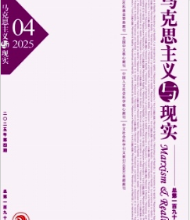
No.4 2025
CONTENTS
Special Feature: 20th Anniversary of the Establishment of Marxist Theory as an Academic Discipline
The Party’s Innovative Theory in the New Era and the Advancement of Marxist Developmental History as an Academic Discipline // Gu Hailiang
Historical Trajectory and Contemporary Relevance of Constructing China’s Independent Knowledge System Based on the Fundamental Tenets of Marxism // Hao Lixin
Twenty Years of Political Communication as a Discipline within Marxist Theory: A Review and Prospects for the Future // Luo Yuting
China’s Study of Marxism Abroad and Its Role in Advancing Marxist Theory Domestically // Wang Yuchen
Research on Xi Jinping Thought on Socialism with Chinese Characteristics for a New Era
The Global Relevance of the Cultural Subjectivity of the Chinese Nation // Han Zhen
A Materialist-Historical Interpretation of Cultural Subjectivity // Wan Guangxia & Wei Haotian
Community Logic and the Four Dimensions of Transcendence in the Ecological Paradigm of Chinese Modernization // Ye Dongna
Research on Fundamental Marxist Theories
A Historical Materialist Perspective on Contemporary Inquiry into Digital Objects and Its Limitations // Liu Riming & Wang Meile
Analytical Paradigms, Core Connotations, and Contemporary Significance of Marx and Engels’ Cultural Perspectives // Sun Jianhua
The Ideological Anatomy of Conceptual-Political Praxis and Its Contemporary Relevance: Re-examining Marx’s Study of the 1848 French Revolution // Liu Chao
Reinterpreting Marx’s Concept of Objectivity: From The Economic and Philosophic Manuscripts of 1844 to The German Ideology // Zhang Zheng
The Debate between Positive Philosophy and the Young Hegelians on the Concept of Freedom: An Examination of Young Marx’s Supportive and Critical Engagement with Their Views //Pan Yuefei
Research on Political Economy with Chinese Characteristics
Theoretical Foundations, Strategic Objectives, Implementation Pathways, and Core Tasks for Achieving High-Quality Development in the Financial Sector // Gu Yan
Mechanisms and Practical Approaches by Which the Platform Economy Facilitates the High-Quality Development of China’s Economy //Chen Hang & Han Wenlong
Dialogue and Interviews
Mapping Indian Marxism: An Interview with Vijay Prashad // Wang Jing
Research on the History of Marxist Development
The Russian Revolution Analyzed through Lenin’s Theory of World History // He Ping
On Lenin’s Reflections on Improving the Conduct of a Proletarian Ruling Party // Xiao Yao
Research on Contemporary Capitalism
A Political Economy Critique of Temporal Domination in the Context of Digital Capitalism // Dai Xuehong & Liu Fuhua
Realistic Depictions and Critical Reflections on the Unregulated Expansion of Digital Capital // Liu Yang & Li Haoyuan
Financialization and Labor Discipline in the Context of Contemporary Capitalism Lucas Prata Feres, Alex Wilhans Antonio Palludeto & Hugo Miguel Oliveira Rodrigues Dias (Translated by Wang Weihong & Sun Daman)
Feature Research
Ideological Risks Posed by Intelligent Algorithmic Technologies: Generative Logic, Primary Manifestations, and Governance Strategies // Li Jiali
The Challenges Posed by Generative Artificial Intelligence to Ideological Discourse and the Corresponding Paths of Adaptation // Liu Wenjun
Research on Marxism Abroad
A Comparative Study of the Frankfurt School and Birmingham School’s Divergent Perspectives on Mass Culture // Wang Fengcai & Li Kexin
The Practice of Buddhist Socialism in Theravāda Buddhist Countries of Southeast Asia // Liu Yumeng
Academic Trends
Adapting Marxism in China: Insights from Latin American Scholarship // Li Ziying & Huang Yunhe
MAIN ABSTRACTS
The Party’s Innovative Theory in the New Era and the Advancement of Marxist Developmental History as an Academic Discipline
Gu Hailiang
Building upon the accomplishments of Marxist development history in the contemporary period, the discipline has experienced significant advancement within the broader development of Xi Jinping Thought on Socialism with Chinese Characteristics for a New Era. A theoretical orientation and methodological framework—encompassing historical, contemporary, and future dimensions—has progressively taken shape. Research on the history of world socialism has intensified, with increased scholarly attention directed toward the historical and contemporary relevance of The Communist Manifesto. Substantial progress has also been made in the compilation, translation, and study of Marxist classics. As part of the evolution of Xi Jinping Thought on Socialism with Chinese Characteristics for a New Era, the discipline of Marxist development history has focused on the historical trajectory and contemporary developments of Marxist theory. This has resulted in an elevation of both its theoretical sophistication and academic scope. Through in-depth studies of the historical progression, theoretical innovations, and intellectual insights embedded in the Party’s theoretical advancements, new academic paradigms and conceptual frameworks have emerged. The discipline has introduced innovative models and revitalized its development, particularly through the unique form of “historical resolutions,” which exemplify the Chinese approach to the study of Marxist development history. Moreover, the discipline has pioneered a distinctive developmental path by aligning closely with the Party’s theoretical innovations in the New Era. This alignment is particularly evident in its focus on the “Four Histories”—namely, the histories of the Communist Party of China, the People’s Republic of China, reform and opening up, and socialist development. Drawing upon the discipline’s theoretical characteristics, ideological foundations, academic implications, and logical structure, scholars have explored new dimensions in the historiography of Marxist development history, thereby deepening and expanding the field.
Historical Trajectory and Contemporary Relevance of
Constructing China’s Independent Knowledge System
Based on the Fundamental Tenets of Marxism
Hao Lixin
The construction of an independent Chinese knowledge system grounded in the fundamental tenets of Marxism has been an ongoing process of exploration and development. Central to this endeavor has been the compilation and publication of textbooks on the fundamental tenets of Marxism, especially under the auspices of the National Project to Study and Develop Marxist Theory, which have significantly contributed to the formation of this knowledge system. In the current New Era, the continuous revision and refinement of the textbooks on the fundamental tenets of Marxism have deepened the comprehensive understanding of these tenets while enriching and expanding the associated knowledge framework. The concept of the “two integrations”—namely, the integration of Marxism’s fundamental tenets with China’s specific realities and with the best of traditional Chinese culture—constitutes both the necessary pathway for adapting Marxism to the Chinese context and the needs of the times and the fundamental strategy for constructing an independent Chinese knowledge system. To accelerate the development of this system, rigorous theoretical research and practical implementation centered on the “two integrations” are essential. This includes a thorough examination and embodiment of the latest theoretical achievements of the Communist Party of China, a deep investigation into the emerging traits and requirements of Chinese modernization, and a systematic exploration of the intersections between the fundamental tenets of Marxism and the best of traditional Chinese culture. These efforts aim to drive the comprehensive innovation of the Marxist fundamental tenets knowledge system.
Twenty Years of Political Communication as a Discipline within
Marxist Theory: A Review and Prospects for the Future
Luo Yuting
Since the establishment of the first-level discipline of Marxist Theory in 2005, Political Communication—as a distinct and foundational second-level discipline—has undergone twenty years of development. This process has been marked by successive stages of autonomous growth, substantive enrichment, and systematic institutionalization. The discipline has played a vital role in guiding political communication discourse, supporting the Party and the nation, serving as a cornerstone for the Marxist Theory discipline, and providing theoretical direction for the practical advancement of political communication. Over the past two decades, the political communication discipline has adhered to six guiding principles. First, it has emphasized upholding foundational integrity while pursuing innovation. Second, it has promoted the cultivation of virtue through education, both by uncovering its underlying theoretical laws and by fostering disciplinary advancement. Third, it has prioritized quality, advocating for substantive and standardized development that links evaluation with construction to foster progress. Fourth, it has unified theory and practice by strengthening theoretical guidance through practical engagement and enhancing theory through empirical reflection. Fifth, it has integrated teaching and research, encouraging mutual reinforcement between education and scholarship. Sixth, it has embraced digital transformation, advancing the digitization of political communication and embedding political content within digital platforms. These six principles collectively represent the accumulated insights of the discipline’s maturation. At this critical juncture, it is of profound significance to reflect upon the developmental trajectory of Political Communication since the inception of the Marxist Theory discipline, to distill its foundational insights, and to envision its future path. Addressing the dialectical relationships between holism and stratification, autonomy and interdisciplinarity, critique and constructive development, and national and global orientations will be essential to promoting the discipline’s high-quality development, enhancing its scientific rigor in the New Era, and fulfilling its role in the national rejuvenation mission.
China’s Study of Marxism Abroad and Its Role in Advancing
Marxist Theory Domestically
Wang Yuchen
China’s study of Marxism abroad originated with the study of Western Marxism. Over time, the philosophical orientation of this field has evolved from initial rejection to critical engagement and eventual acceptance. The objectives of such study have shifted from introductory critique to serving as a theoretical resource for the development of Chinese Marxist theory and the practical demands of modernization. The interpretation and evaluation of foreign Marxist thought are shaped by the foundational Marxist principles upheld by Chinese scholars. Conversely, the study of Marxism abroad has informed and enriched the development of indigenous Marxist theoretical paradigms. These studies have enhanced the understanding of Marxist philosophy’s core essence and contributed to the construction of China’s Marxist theoretical system, opening new avenues of discourse and scholarly inquiry. Nevertheless, certain limitations remain. These include a tendency to overlook economic foundations, an overemphasis on human subjectivity, and a dichotomization of the academic and practical dimensions of Marxist theory.
The Global Relevance of the Cultural Subjectivity of the Chinese Nation
Han Zhen
Chinese national cultural subjectivity refers to the Chinese people’s awareness, distinctiveness, and autonomous capacity in shaping their cultural development. Without cultural subjectivity, a nation cannot sustain its historical continuity, evolutionary trajectory, or future prosperity. This subjectivity is revealed through the nation’s historical development. The history of the Chinese nation reflects the gradual transformation of its cultural subjectivity from a latent to an explicit condition. Despite the cyclical rise and fall of dynasties throughout Chinese history, the core of Chinese culture has remained intact. Time and again, Chinese civilization has experienced revival and flourishing. This historical continuity demonstrates the enduring strength of Chinese cultural subjectivity and the intrinsic vitality of Chinese civilization. In the modern era, despite persistent suppression, distortion, and marginalization by dominant Western cultures, Chinese civilization has overcome adversity, achieved renewed growth, and asserted its presence within the global civilizational landscape. This marks a modern revitalization of Chinese civilization and underscores the contemporary relevance and international significance of Chinese cultural subjectivity.
The Russian Revolution Analyzed through Lenin’s Theory of World History
He Ping
As early as the 1870s and 1880s, Russia attracted the scholarly attention of Marx and Engels, who incorporated it into their theoretical framework of world history. Observing Russia’s transition from a pre-capitalist to a capitalist society, they initially viewed it as a passive participant in the global historical process. Their hypothesis suggested that “if the Russian Revolution becomes the signal for a proletarian revolution in the West, so that both complement each other.” In light of Russian social developments in the 1880s and 1890s, Lenin offered a reinterpretation of this hypothesis. Through a systematic analysis of Russia’s capitalist transformation and the particularities of its revolutionary movement, Lenin concluded that the Russian Revolution would enable the country to assume an active role in shaping world history. Building upon this theoretical foundation, Lenin analyzed both the internal and external conditions that made Russia’s proletarian revolution possible. Internally, Russia had developed what Lenin described as the world’s most revolutionary proletariat. Externally, historical circumstances endowed the Russian working class with a mission to fundamentally reshape the global order. Through his in-depth analysis of the Russian case, Lenin elucidated the underlying mechanisms of historical development that often appear contingent. In doing so, he expanded upon Marx and Engels’ original world historical theory.
英文目录和摘要审校 童孝华
No.4 2025
- No. 6 2025
- No. 5 2025
- No. 4 2025
- No. 3 2025
- No. 2 2025
- No. 1 2025
- No. 6 2024
- No. 5 2024
- No. 4 2024
- No. 3 2024
- No. 2 2024
- No. 1 2024
- No. 6 2023
- No. 5 2023
- No. 4 2023
- No. 3 2023
- No. 2 2023
- No. 1 2023
- No. 6 2022
- No. 5 2022
- No. 4 2022
- No. 3 2022
- No. 2 2022
- No. 1 2022
- No. 6 2021
- No. 5 2021
- No. 4 2021
- No. 3 2021
- No. 2 2021
- No. 1 2021