
Sun Chenghao:The Shifting Transatlantic Alliance
2026-11-05 11:15:50 | Author: Sun Chenghao | Source:en.qstheory.cn2026-11-02
The transatlantic alliance has suffered severe shocks in recent years. Doubling down on “America First,” the current US administration is demanding that Europe shoulder greater security responsibilities while maintaining persistent pressure on Europe across trade, science, and technology. While continuing to cooperate within the alliance, Europe is accelerating its pursuit of strategic autonomy and defense capacities. Differences between the two sides regarding defense burden-sharing, economic and trade rules, technology governance, and the international order have grown increasingly prominent.
I
The transatlantic alliance is far from a mere marriage of convenience; rather, it is a long-standing alliance built on three foundational pillars: security structures, institutional ties, and shared core values. Since the end of World War II, the alliance has weathered multiple challenges, including Cold War confrontation, the collapse of the Soviet Union and the subsequent restructuring of the global order, the War on Terror, and major-power rivalry.
To meet the needs of the Cold War, 12 countries—including the United States, the United Kingdom, and France—signed the North Atlantic Treaty in 1949, establishing the North Atlantic Treaty Organization (NATO) with the so-called “collective defense” as its core principle. Its terms stipulate that an armed attack against one NATO member shall be considered an attack against them all. The establishment of NATO marked a high degree of security integration between the US and Europe. At the time, the core logic of the alliance was a “security community,” defined by joint response to external threats. The US maintained a long-term large-scale troop presence in Europe, assuming the role of NATO’s leader, while most European countries relied heavily on the American nuclear umbrella and its superior military and intelligence capabilities. Although the US and Europe held divergent views on specific issues such as strategic autonomy, nuclear policy, and military deployment, these differences were consistently overshadowed by paramount security needs. Facts from this period show that as long as external threats are sufficiently intense, intra-alliance friction remains secondary.
The end of the Cold War drastically reduced the external threats facing the US and Europe. Under conventional alliance theory, the transatlantic alliance should have loosened or even dissolved. In reality, the exact opposite occurred: rather than vanishing, NATO expanded and evolved in function. At the end of the Cold War, NATO had only 16 member states; by July 2026, membership had doubled to 32. Its functions have also gradually broadened from traditional collective defense to regional intervention, counter-terrorism cooperation, cybersecurity, and various other fields. Key to this evolution is its institutionalized operations: the NATO-centered transatlantic institutional system has shaped US-European security cooperation through rules, procedures, and organizational structures, shifting the alliance from “threat-driven” to “institution-driven.” Stable mechanisms not only provide platforms for deliberation and decision-making, but also—through bureaucratic collaboration, civilian-military coordination, military synergy, and long-term cooperation—generate path dependency, thereby raising the costs of a “breakup.” Even amid the recent waning of US commitment to European security, and Europe’s increasing emphasis on strategic autonomy, NATO’s institutional continuity still keeps both sides anchored within the alliance framework. As the Russia-Ukraine conflict drags on, US-Europe disagreements over defense cost-sharing have emerged. Nevertheless, compelled by security needs, European countries have significantly increased defense spending and added more defense cooperation mechanisms. This further demonstrates that mechanisms themselves have become a vital foundation for sustaining the transatlantic alliance.
The transatlantic alliance is not merely about security cooperation; it also means a political and ideological identity built upon so-called values such as “freedom” and “democracy.” Unlike security structures and institutional mechanisms, ideological identity is not confined to a single historical phase; rather, it is a cultural bond and spiritual foundation running through the alliance’s entire evolution. During the Cold War, the US and Europe gradually forged a shared political and ideological identity. From the 1990s to the early 21st century, the US and Europe generally viewed their own institutional models as attractive, and their strategic focus gradually shifted from maintaining the existing security order to shaping and expanding a US-European-dominated international order. Whether in NATO’s eastward expansion, EU enlargement, or external operations launched in the name of “promoting democracy,” each bore the distinct imprint of exporting values. Even after major disagreements arose over issues such as the Iraq War, the US and Europe maintained a high degree of consensus on the so-called “liberal international order.” Their shared discourse and common values regarding global governance, international organization reform, and international rule-making transformed the transatlantic alliance from a traditional military alliance into a broad strategic alliance with distinct political attributes and bloc characteristics.
II
In recent years, trade friction, defense burden-sharing disputes, and divergences in strategic outlook within the transatlantic alliance may appear on the surface as mere policy disputes; but in reality they reflect profound shifts in the economic foundation, political ideals, and shared values that have underpinned their long-term cooperation.
At the economic level, economic globalization has not only transformed the relationship between the West and the wider world, but also eroded the economic development consensus between the US and Europe. Free trade, multiculturalism, and the Western-dominated international institutional framework that emerged after the Cold War once served as crucial pillars of their joint promotion of the so-called “liberal international order.” However, as economic globalization deepened, problems such as industrial relocation, the loss of manufacturing jobs, widening income gaps, and regional developmental imbalances continued to accumulate, leaving certain groups as “losers” of globalization. Particularly in the wake of the 2008 global financial crisis, Western society’s confidence in free markets and economic globalization manifestly weakened, with a growing segment of the public questioning whether an open economic system could still deliver widespread prosperity. In their response to the shocks of economic globalization, the US and Europe have shown increasingly pronounced differences. The US shifted early toward a new economic strategy centered on industrial policy, trade protectionism, and supply chain security. It placed greater emphasis on leveraging sovereign state power to bolster national capacities, reshape strategic planning, and reallocate resources to revitalize its domestic economy and enhance strategic competitiveness. Whether through “America First,” manufacturing reshoring, or strengthened industrial subsidies and economic security policies, its actions reflect an adjustment—or even revision—to the neoliberal-dominated model of economic globalization. By comparison, Europe, while facing similar issues such as declining industrial competitiveness and sluggish economic growth, is constrained by its supranational governance model and member-state coordination mechanisms. As a result, it generally pursues reform within the framework of open markets, free trade, and multilateral economic systems, preferring to advance policy adjustments through rule-based frameworks and collective consultation. Consequently, disagreements between the US and Europe in areas such as trade, industrial policy, economic security, and supply chain restructuring continue to increase.
At the political level, identity and “boundary” issues have emerged as core topics. Following the end of the Cold War, as common external threats weakened and economic globalization deepened, who belongs to “the West” and how community boundaries should be defined gradually became major subjects of political debates within both the US and Europe. The United States has increasingly emphasized the priority of national borders, sovereignty, and citizenship, leaning toward grounding its political community on the nation-state. Europe, by contrast, has long been committed to supranational integration, seeking to foster a broader European identity beyond national identity. In recent years, the immigration crisis, refugee issues, and dilemmas of social integration have further amplified these divergences. As a result, the divergences between the US and Europe are no longer merely about specific immigration policies; they represent an identity struggle over “who counts as Western” and “where the boundaries of the West lie.”
The two sides also differ in their approaches to international responsibility. After the Cold War, both viewed themselves as architects of the global order and promoters of international rules, regarding multilateralism, free trade, human rights narratives, and institutional export as key manifestations of their own strengths. In recent years, their understandings of what international responsibilities to assume and how to shape the international order have gradually diverged. The current US administration no longer views maintaining the Western and global order as a “responsibility”; instead, it emphasizes “America First” and demands that Europe demonstrate its value to the alliance at a higher cost. Europe, by contrast, still tends to view multilateralism, normative expansion, and global governance as integral to its international identity, while keeping vigilant against increasingly explicit US unilateralism. Debates within Europe regarding “US reliability,” “strategic autonomy,” and “European responsibility” continue to heat up, reflecting Europe’s concerns over the changing US role and a rethinking of its own positioning. This divergence in understanding international responsibilities has continuously widened policy disagreements between the two sides on issues such as security, economy and trade, technology, climate change, and global governance.
It should be noted that the changes currently taking place in the transatlantic alliance do not imply that common interests and the foundation for cooperation between the US and Europe have vanished; rather, it is the underlying logic sustaining the alliance that is undergoing adjustment. Although it is increasingly difficult for both sides to sustain the highly aligned strategic consensus of the post-Cold War era, their common needs regarding security interests, institutional ties, and global interests persist. Whether in addressing regional security risks, preserving transatlantic economic ties, or coordinating global issues, both sides still need to cooperate with each other, and neither can afford the cost of a complete rupture in the alliance. It is precisely for this reason that the transatlantic alliance will not collapse merely because of growing differences; instead, amid persistent common interests and weakening shared perceptions, it is far more likely to enter a new phase of adjustment.
III
From a longer-term perspective, security cooperation, economic and trade ties, and institutional coordination within the transatlantic alliance will continue to play an important role. However, its internal cohesion will be increasingly shaped by practical needs and strategic considerations.
From the US perspective, its posture toward the transatlantic alliance is shifting from “leading the West” to “managing the alliance,” a transition driven by shifts in its domestic and foreign strategic priorities. Compared with its long-standing post-Cold War role as the “guardian” of the Western liberal international order, the US is increasingly prioritizing domestic economic competitiveness, industrial development, and social governance, while increasingly directing its limited resources to the “Indo-Pacific” region and other directions of greater strategic importance. Consequently, while the transatlantic alliance’s importance has not substantially declined, its function is undergoing an adjustment. In the future, it will increasingly serve US efforts to maintain its external competitiveness and shape a favorable strategic environment. Against this backdrop, the US will not easily abandon Europe as a key ally; its support for Europe will continue, but with a heightened emphasis on “costs and benefits.”
From Europe’s perspective, the transatlantic alliance is transitioning from reliance on the US toward strengthening its own strategic autonomy. In recent years, Europe has been advancing defense cooperation, defense-industrial integration, economic security, and critical technology capacity-building, gradually translating strategic autonomy from a political proposition into concrete policies. However, disparities remain across Europe in levels of development, security perceptions, and strategic cultures, while the US-provided nuclear deterrence, intelligence architecture, and strategic projection capabilities remain irreplaceable in the short term. Thus, the realistic objective of European strategic autonomy is not to decouple from the US, but to enhance its own capacity for action, risk resilience, and policy autonomy while maintaining alliance relations. Europe is increasingly recognizing that genuine strategic autonomy is reflected not only in military capacity building, but also in industrial competitiveness, technological innovation, and the capacity to shape global rules. How to strengthen its strategic agency while maintaining cooperation with the United States will constitute a major challenge for Europe in managing transatlantic alliance relations in the days ahead.
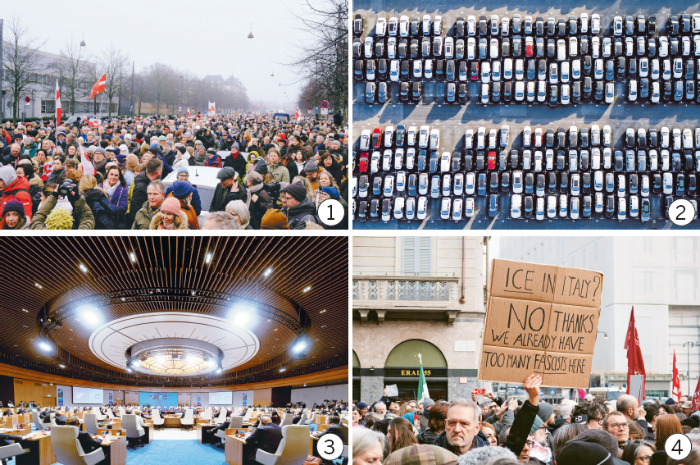
1. People march to protest against US plans for Greenland outside the US Embassy in Copenhagen, Denmark, January 17, 2026, local time.
2. A large number of new vehicles are parked at a logistics center in Essen, Germany, awaiting shipment, April 5, 2025, local time. Earlier, the White House announced a blanket 20% tariff on all goods imported from the EU.
3. NATO leaders attend the NATO summit in Ankara, Türkiye, amidst deep divides over issues such as defense spending shares between the US and Europe, July 8, 2026, local time.
4. People in Milan hold a protest against the planned presence of US Immigration and Customs Enforcement (ICE) agents in Italy for the 25th Winter Olympics, January 31, 2026, local time. XINHUA, VISUAL CHINA
The shifts in the transatlantic alliance will further exert profound impacts on the international system and global governance. At the international system level, internal adjustments within the alliance imply a relative decline in the capacity of the US and Europe to lead the international agenda and shape global rules. In the future, international politics will feature growing interaction and coordination among diverse powers, rather than an order dictated by a single power. Global South countries and emerging major countries will gain greater autonomy in international affairs, further amplifying their voice in reforming global governance systems, international financial governance, global climate governance, and digital governance. At the level of global governance, divergences in perceptions and interests within the transatlantic alliance may weaken its coordination on certain international issues, making the global governance system more consultative, pluralistic, and decentralized. In the future, international rule-making will rely more on coordination and cooperation among various countries and regions, rather than being primarily driven by a few Western countries.
The profound adjustment of transatlantic alliance relations also demonstrates that the old security logic based on exclusive alliances, bloc division, and group politics is increasingly unsuited to the trend of the times toward multipolarity, economic globalization, and greater democracy in international relations. Driven by profound shifts in the international balance of power and the collective rise of developing countries, an increasing number of countries seek to participate in international affairs as equals and jointly shape global rules, rather than passively accepting institutional arrangements dictated by a few Western countries. Against this backdrop, Global South countries, with China as a key representative, champion the vision of building a community with a shared future for humanity. Aligning with the trend toward greater democracy in international relations, upholding true multilateralism, and advocating an equal and orderly multipolar world together with a universally beneficial and inclusive economic globalization, these countries will surely help to foster a more just and equitable international order.
Sun Chenghao is a scholar at the Center of Tsinghua Think Tank, Tsinghua University.
(Originally appeared in Qiushi Journal, Chinese edition, No. 15, 2026)
Source: English Edition of Qiushi Journal,2026 No.5