
Shen Zhuanghai:Devotion to Family and Country
2026-11-05 10:13:26 | Author:Shen Zhuanghai | Source:en.qstheory.cn2026-11-02
Devotion to family and country embodies the enduring Chinese belief that the wellbeing of the family is intertwined with that of the country. It arouses a deep attachment of the Chinese people to their home and inspires them to devote themselves to and strive for their country and shoulder their responsibilities. At once touching and noble, it is a notion rich in Chinese cultural character and enduring in its appeal. At the meeting on Cultural Inheritance and Development held in Beijing on June 2, 2023, President Xi Jinping summed up the essence of the notion as self-cultivation, family management, state governance, and bringing peace to all and shouldering responsibility for the nation’s fate. He also expounded its value and significance by analyzing traditional Chinese cultural elements and the defining characteristics of Chinese civilization that these elements have collectively shaped.
The ideal of “cultivating oneself, managing the family, governing the state, and bringing peace to all” has deep historical roots. It was systematically articulated in the Daxue, or The Great Learning, a chapter in The Book of Rites, one of the classics of the Confucian canon that describes the social forms, administrative structures, and ceremonial rites of the Zhou Dynasty (1046-256 BC). Self-cultivation is the foundation of family management, state governance, and peace for all, and these, in turn, are the very purpose of self-cultivation. This progressive and interconnected sequence embodies both lofty ideals and a deep sense of responsibility. Throughout history, self-cultivation, family management, state governance, and bringing peace to all have been regarded as a progressive path of learning, moral cultivation, and self-development, forming the core of the Chinese scholar-official ethos.
In the Qing Dynasty (1616-1911), thinker and historian Gu Yanwu extended the responsibility for safeguarding all under heaven to every ordinary individual, asserting that even the humblest common man shares the responsibility. Gu’s epigram captures the progression from self-cultivation to peace for all. At the end of the 19th century, the modern Chinese thinker Liang Qichao built on this idea and put it in more general terms, stressing that the survival of a nation is the responsibility of every individual. This call rapidly resonated across China at a time of acute foreign aggression and a grave national crisis, forging a collective resolve among the people to willingly shoulder the responsibility for national salvation and survival.
In essence, the ideal of “self-cultivation, family management, state governance, and bringing peace to all” champions virtue—a form of moral conduct that begins with self-cultivation and extends outward, serving as a path toward fulfilling the life ideals of ancient Chinese sages. Meanwhile, the notion that the survival of a nation is the responsibility of every individual focuses on awakening individuals to their responsibility, moving from the outer to the inner and reflecting the progression from self-cultivation to peace for all. The two are thus integrated in the development of the Chinese nation.
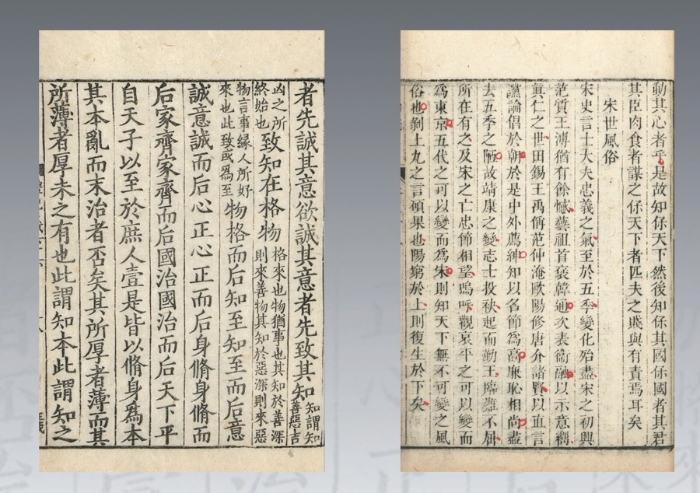
The essence of devotion to family and country lies in cultivating oneself, managing the family, governing the state, and bringing peace to all, as well as shouldering responsibility for the nation’s fate. These are integrated into the development of the Chinese nation.
Left: The Song Dynasty edition of The Commentary on the Book of Rites.
Right: The Qing Dynasty edition of the Chapter of Zhengshi Era from Record of Daily Knowledge.
THE ANCIENT BOOKS LIBRARY OF THE NATIONAL LIBRARY OF CHINA
Devotion to family and country, encompassing the ideal of self-cultivation, family management, state governance, and bringing peace to all, took root in the fertile soil of China’s agrarian civilization. China has been an agricultural country since ancient times, and its agrarian civilization, spanning several millennia, laid the material foundation for the survival of the Chinese nation and left upon it a culture imprint deeply rooted in the soil.
For the Chinese, the soil of their homeland is both the source of life and the ultimate resting place for the soul, a concept expressed by anthropologist and sociologist Fei Xiaotong in his From the Soil: The Foundations of Chinese Society: “Chinese society is fundamentally rural,” and “Only those who depend on the soil for their livelihood would root themselves in one place like a plant.” Farming gave rise to a mode of operation centered on the family. Beginning with the family and clan, and with the individual as the starting point, people expanded their sphere of concern from the immediate to the distant, transforming their filial obligations rooted in kinship ethics into a sense of duty to serve the country within the realm of political ethics. Ultimately, the individual and the collective were brought into alignment, thereby constructing the social and state order.
The state governs its people through law and moral teachings, while the family regulates its members through domestic rules and clan regulations. Together, they establish a stable order. The rural roots, anchored in the family, are elevated into a devotion to the country that transcends kinship and locality, and underpins the profound order that sustains individual lives, family continuity, social stability, and the functioning of the state.
During the Western Zhou Dynasty (1046-771 BC), the state and the clan were highly integrated, with state power and clan authority unified into one. The civilized norms of rites and music served as the bond that maintained and buttressed not only the hierarchical order of the clan but also the political order of the state.
During the Spring and Autumn (770-476 BC) and the Warring States (475-221 BC) periods, advances in technology and agriculture significantly promoted productivity, which in turn brought about profound transformations across the social, economic, and political landscapes. It was a period marked by the disintegration of the traditional clan-based feudal order, the collapse of the old order of rites and music, and incessant warfare among the feudal states. It was also a crucial epoch in which new ideas and new orders were conceived and nurtured amid the turbulence.
Troubled by the chaos of the times, when “all under heaven fell into confusion and the wise and the worthy were ignored,” the “hundred masters and schools of thought”—regarded as constituting a golden age of Chinese philosophy—emerged, exploring paths and methods to reconstruct the order of family and state and to bring peace to all. Confucius emphasized, “What rulers of states and chiefs of families concern themselves with is not scarcity but the lack of even distribution, not poverty but the lack of stability.” He advocated, “If distant peoples are not submissive, then cultivate the influences of civil culture and virtue to attract them to be so.” To realize his political ideal of “all under heaven returning to benevolence,” he led his disciples to travel through the kingdoms, holding fast to his principles in every circumstance. His journey demonstrated the resolve of a man “who knows the cause is unlikely to succeed, yet pursuing it anyway.” Though the philosophies of other masters like Laozi, Mozi and Mencius diverge in many respects, they too share a commitment to statecraft, the welfare of the world, and the pursuit of peace for all.
During the transition from the Qin (221-206 BC) to the Han (206 BC-AD 220) dynasties, the people suffered greatly from harsh governance and incessant warfare. The Huainanzi, the ancient philosophical and political text completed in the early Western Han (206 BC-AD 25) period, echoed the prevailing aspiration for stability and good governance by drawing lessons from the successes and failures of governance in previous dynasties. It posited that the ideal of self-cultivation, family management, state governance, and peace for all constituted the essential art of statecraft that rulers must master in order to achieve their vision of good governance.
In the era spanning the Tang (618-907) and Song (960-1279) dynasties, enlightened monarchs, such as Tang Emperor Taizong, recognized that “to bring peace to all, one must first rectify one’s own conduct.” Confucian literati and officials, such as Han Yu and Fan Zhongyan, championed the principles of “taking the affairs of the state as one’s own responsibility” and “being the first to care and worry, and the last to enjoy pleasures.” And when the nation was in peril, they held that one should “never forget one’s concern for the nation, however humble one’s position.”
All this expressed the sense of responsibility that defined the scholar‑officials. It was precisely this aspiration for peace for all and this ethos of responsibility that inspired the people of the Qin‑Han and Tang‑Song eras to strive for the good governance and peace that later generations widely acclaimed.
The Ming (1368-1644) and Qing dynasties were a pivotal transitional period during which economic productivity underwent imperceptible changes, and the traditional social structure started to show signs of fraying and loosening. Correspondingly, the ideal of self-cultivation, family management, state governance, bringing peace to all, and shouldering responsibility for the nation’s fate, took on richer and more developed meanings. One notable feature of this enrichment was the increasingly prominent role and importance of ordinary people.
Devotion to family and country, held by men of high ideals, is distinctly people-oriented and carries a deep concern for the conditions and hardships of the people. They cherish the people, view people’s suffering as their own, show deep concern for people’s wellbeing, regard people as the foundation of the state, and devote themselves to advocating on behalf of the people. This devotion is deeply rooted in the heart of the Chinese nation and has become a vital part of its cultural genes.
The Chinese notion that the family is the smallest unit of the country and the country is made up of countless families stresses the interconnectedness between families and the country. The harmony and happiness of the family is closely related to the stability and strength of the country. The ideal of cultivating oneself, managing the family, governing the state, and bringing peace to all, together with shouldering responsibility for the nation’s fate, vividly illustrates the unity of loving both one’s family and one’s country, as well as a conscious recognition that the country takes precedence over the family.
On the one hand, the family is the foundation of the country and the basic unit of society. The country flourishes only when families thrive, and the “big family” of the country prospers only when every individual “small family” is full of vitality. On the other hand, the family relies on the country for its existence: only when the country is stable and prosperous can people’s wellbeing be ensured, and without national prosperity and development, there can be no family happiness and fulfillment.
It is deeply ingrained in the Chinese people that the family and the country are inextricably linked; filial piety at home, loyalty to the country, and loving the country as one’s own family constitute the core values most deeply held in their devotion to family and country. However, when filial piety and patriotic devotion come into conflict, numerous patriots have unhesitatingly chosen to sacrifice family interests for the greater good of the country. Such devotion goes beyond mere personal emotion. It extends from the individual self and the immediate family to the collective wellbeing of countless households, and from the present to all generations. It is this enduring devotion that has driven the Chinese people to strive unremittingly for the country’s prosperity and development.
Devotion to family and country has greatly strengthened the cohesion of the Chinese nation
What makes China truly China is that the countless Chinese people born and raised on this land have their emotional bonds rooted here, and find their sense of identity in it. Throughout the millennia of Chinese history, despite the rise and fall of dynasties and periods of division and reunification, the Chinese nation has always achieved unity and now stands tall among the nations of the world.
The various ethnic groups of China have thrived together on this vast land, bound by deep-seated blood ties and kinships. Throughout the historical process of jointly forging, developing, and safeguarding a great unified country, they have stayed in harmony, grown close to one another, and shared weal and woe together. Gradually, they have coalesced into an indivisible community of shared destiny—one that is diverse yet connected, intermingled and united.
Many factors drive the formation and consolidation of this community of shared destiny, among which the profound devotion to both family and country stands out. Following the ideal of self-cultivation, family management, state governance, and bringing peace to all—both in thought and practice—the Chinese people have extended their deep attachment from home outward, embracing neighbors and society as well, and have thereby forged a powerful bond that holds society together.
For the Chinese people, family and country serve as the ultimate anchor of life and meaning. From this conviction grows a deep and steadfast commitment to unity—a realm where all regions share one culture, all lands are joined as one, and all under heaven is settled in oneness. These ideas and sentiments have forged a shared conviction: the territory must remain indivisible, the state must never fall into chaos, the country must never fragment, and its civilization must never be broken.
Devotion to family and country has nurtured and enriched the spirit of the Chinese nation
Devotion to family and country is not simply a personal feeling; rather, it is a unity of knowledge, emotion, will, and action. Without action, it can never be transformed into genuine commitment. Throughout thousands of years in which the Chinese nation has shaped its history and brought forth its civilization, countless patriots have taken the ideal of self-cultivation, family management, state governance, and bringing peace to all as their mission. They have consciously bound their personal emotions and pursuits to the destiny of the country, demonstrating a profound understanding of and unwavering commitment to their responsibilities toward their country. Through these enduring efforts, they have forged a great national spirit with patriotism at its core.
The Chinese national spirit is the inexhaustible wellspring of the country’s vitality, cohesion, and creativity. It represents a synthesis of the established patterns of thinking, value orientations, psychological structures, and customary practices that have been shaped and passed down through history. Embedded at the deepest level of the Chinese cultural and ideological framework, this national spirit cements the nation and the national identity, buttresses its survival and drives it forward.
World history tells us that ancient civilizations of Egypt, Babylon, India, Greece, and Rome have all come to an end. The Chinese civilization, in contrast, has weathered numerous hardships to retain its vigor and vitality, passing its legacy on from generation to generation. As the only civilization in the world that has continued to the present day in the form of a state, it is inseparable from the spirit of the Chinese nation.
History and reality have shown time and again that a nation bereft of a spiritual ethos cannot achieve self-reliance and self-improvement, nor can it secure a rightful place among all nations, let alone realize national rejuvenation and stand at the forefront of global advancement. The Chinese national spirit is deeply ingrained in the blood and soul of its people, acting as a powerful driving force that underpins the country’s perpetual vitality and propels it steadily onward and upward.
Devotion to family and country has sustained the Chinese nation through storms, in the defense of the homeland, and in overcoming difficulties
The long, surging river of history is marked by both calm waters and treacherous rapids. Down through the ages, the Chinese nation has weathered countless trials and tribulations. Yet no matter the difficulties or challenges it has encountered, it has always persevered and prevailed. The key reason lies in the deep-rooted sense of family and country and in the way innumerable heroes have stepped forward in times of crisis.
In modern times, when an unprecedented crisis threatened the very survival of China and its people, the resolve to defend the homeland surged from the deepest core of the nation, becoming an unstoppable and indestructible force. Millions upon millions of sons and daughters of China sacrificed their personal interests for the public good and for the country, and waged a long and unyielding struggle. In successive wars against foreign aggression, countless patriotic soldiers fought with great courage and faced death unflinchingly, striking hard at the enemy and upholding the dignity of the nation. Especially in the War of Resistance Against Japanese Aggression, the Chinese people rallied together as one and fought tenaciously until they prevailed. That heroic feat of the Chinese nation stands as a marvel in the annals of war.
Why has the Chinese nation been able to survive and continue to develop for thousands of years? A key reason lies in its national spirit centered on patriotism, and in its consistent value pursuits throughout the ages. For millennia, the Chinese nation has inherited and carried forward its devotion to family and country, which is its spiritual lifeblood. On the new journey in the new era, it provides both the spiritual nourishment and driving force that will enable the nation to continue writing a glorious chapter and realize its dreams.
Shen Zhuanghai is Executive Deputy Secretary of the CPC Committee of Wuhan University and Professor at its School of Marxism.
(Originally appeared in Qiushi Journal, Chinese edition, No. 14, 2026)
Source: English Edition of Qiushi Journal,2026 No.5