
Zhang Zhiqiang: Chinese Civilization: Distinctive Features and Order
2026-09-22 16:07:12 | Author:Zhang Zhiqiang | Source:English Edition of Qiushi Journal 2026-09-18
At the Meeting on Cultural Inheritance and Development in 2023, President Xi Jinping pointed out that Chinese civilization is distinguished by its continuity, innovativeness, unity, inclusiveness, and peacefulness. To understand these five distinctive features, we must move beyond merely cataloging historical phenomena and cultural representations to grasp the intrinsic connections among them and the deeper logic toward which they collectively point. This underlying logic is embodied in a unique civilizational order—a set of internal principles that take shape as a civilization builds a community, pursues continuity, integrates values, and coordinates differences.
On further examination, it is possible to distill these five distinctive features into two interrelated concepts. The first is the concept of grand unification, captured in the idea that “all under Heaven are of one family.” Underpinning this concept are the traits of unity and inclusiveness. The second is the concept of comprehensive history, rooted in the principle that “stagnation leads to change, change to adaptation, and adaptation to endurance.” This process unfolds through the interplay between continuity and innovativeness. Peacefulness, for its part, represents a distinctive character that Chinese civilization has displayed in handling internal and external relations, the relationship between past and present, and inter-civilizational relations. It is through the integration of these two concepts that Chinese civilization has taken on a structure defined by wholeness, openness, continuity, and creativity. From this perspective, the significance of Chinese civilization lies not only in its long history, but more fundamentally in the civilizational order it embodies, which offers theoretical resources for understanding contemporary civilizational issues in ways that differ from mainstream Western theories.
I
The grand unification concept of “all under Heaven are of one family” addresses how Chinese civilization has forged a community across a vast space. Grand unification does not erase differences, still less does it impose uniformity at the expense of diversity. Rather, it forms a higher-level holistic order on the basis of acknowledging and accommodating differences.
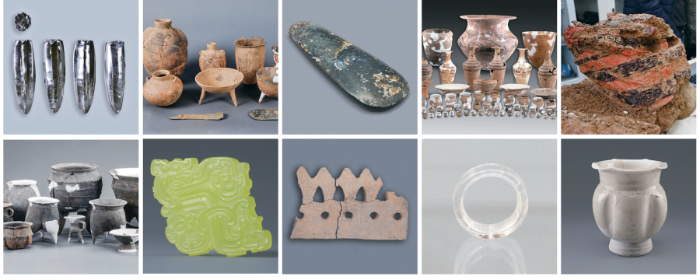
Artifacts unearthed from China’s top 10 archaeological discoveries in 2025. China announced its 2025 list on April 29, 2026. XINHUA / PHOTO PROVIDED BY THE OFFICE FOR THE PROMOTION OF NATIONAL TOP 10 ARCHAEOLOGICAL DISCOVERIES
In traditional Chinese political culture, the notion of “all under Heaven” (Tianxia) has never been a narrow or insular geographical concept, nor has it simply referred to a boundary of rule defined solely by force. Rather, as an order-oriented concept of space with universal implications, it explains the Chinese civilization’s fundamental understanding of the world order and communal life: different regions, ethnic groups, and cultures are not inherently locked into irreconcilable hostile relations, but can be integrated into an ethical-political structure that enables communication, coordination, and coexistence.
The structural embedding of the concept of grand unification hinges on the distinct moral connotations of the word Zhong (the center) in Chinese civilization. China calls itself Zhong Guo (the country in the center), not out of self-aggrandizement, as though claiming to be a geographical or political center of power, but rather to signify the virtue of rising above partial interests to uphold fairness and holistic balance. Zhong thus expresses a vision of order grounded in concern for the whole and service of the common good.
In the context of Chinese civilization, unity has never been a mechanical uniformity that excludes differences; it is an organic unity capable of bringing diverse regions, ethnic groups, and traditions into a shared order. Similarly, its inclusiveness is not about creating an indiscriminate patchwork, but a comprehensive assimilation realized within a framework of communal identity and shared values. The complementary nature of its unity and inclusiveness stems from the fact that Chinese civilization has shaped itself based on an open understanding of community.
Viewed more broadly, the concept of grand unification extends beyond political integration to shape ethical education, institution building, and cultural development.
In Chinese civilization, culture has never been merely about material adornment or formal codes; it is a practical force for cultivating minds, fostering order, and shaping communal life. This understanding has given rise to a unique view of civilization. Civilization is not a marker of identity that is asserted by excluding others, but a historical process that continuously unfolds by the shaping of relationships, the resolution of tensions, and the transformation of differences. Far from posing a threat to the community, differences are the very ingredients that make a higher-level order possible.
History bears this point out. After unifying the six states, the Qin Dynasty (221-206 BC) established the prefecture and county system and standardized axle widths, writing, and ethical norms to lay the foundation for a unified multi-ethnic state. While inheriting Qin institutions, the Han Dynasty (206 BC-AD 220) adopted the policy of extending favor to curb the power of feudal principalities and established Confucianism as the sole ortho doxy to consolidate grand unity. During the Sui (581-618) and Tang (618-907) dynasties, unity was once again restored, inclusiveness was embraced, and aristocratic barriers were broken down through the imperial examination system, paving the way for an era of remarkable vitality. The Yuan (1206-1368) and Qing (1616-1911) dynasties later established their rule in the Central Plains while inheriting Chinese political institutions and traditions.
Across several millennia, Chinese civilization has consistently balanced the relationships among multiple regions, ethnic groups, and traditions. While maintaining overall unity, it has accommodated rich diversity, thereby creating a civilizational pattern of pluralistic unity that has provided the profound support necessary for a unified multi-ethnic state.
II
The concept of comprehensive history, which is grounded in the relationship between stagnation, change, adaptation, and endurance, helps explain how Chinese civilization has maintained continuity and achieved self-renewal over its long history. Despite dynastic changes, social upheaval, and external shocks, Chinese civilization has continued from one generation to the next. The underlying reason for this lies not in a refusal to change, but in the capacity to preserve and renew itself precisely through change. This proposition succinctly captures a central insight into the historical wisdom of Chinese civilization: “endurance” is not stagnant adherence to the status quo, but the acquisition of lasting vitality through continuously responding to difficulties, adapting to changing circumstances, and achieving regeneration.
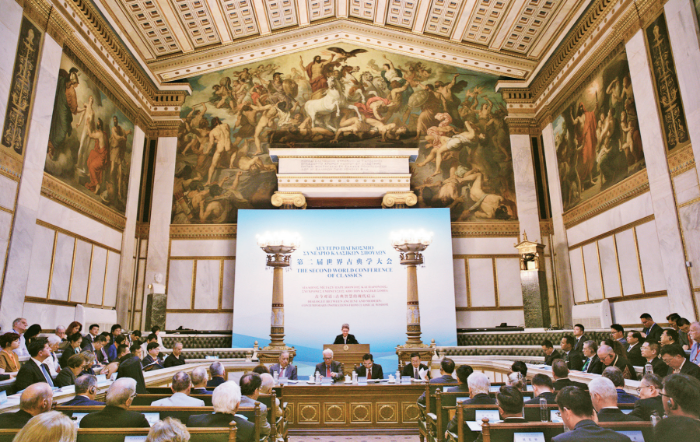
The scene of the Second World Conference of Classics. The conference opened in Athens, Greece, June 9, 2026, under the theme of “Dialogue Between Ancient and Modern: Contemporary Inspirations from Classical Wisdom.” It highlighted the relevance of classical wisdom in addressing contemporary global challenges and promoting the development of human civilization. XINHUA / PHOTO BY MARIOS LOLOS
The continuity of Chinese civilization has never been rigid, conservative, isolationist, or static. Rather, it manifests as a historical process of dialectical unity between continuity and innovativeness. This is rooted in the fact that Chinese civilization does not view tradition as a fossilized entity, but as an intellectual resource that can be continuously reinterpreted, transformed, and renewed. From the numerous schools of thought in the pre-Qin period (before 221 BC) to the classical scholarship of the Han Dynasty (206 BC-AD 220), the Neo-Daoism (Xuanxue) of the Wei-Jin period (220-420), the Neo-Confucianism of the Song Dynasty (960-1279), and Wang Yangming’s School of Mind in the Ming Dynasty (1368-1644), each intellectual tradition has inherited and absorbed the cultures of the preceding period, integrating, synthesizing, deepening, further developing, and transforming their ideas. This has allowed Chinese culture to achieve remarkable continuity while repeatedly reaching new peaks. It also speaks to the unique strengths that have enabled Chinese civilization’s innovation, creation, and sustained development.
More importantly, the concept of comprehensive history is not merely a historiographical notion, but a civilizational practice that connects past and present. Chinese civilization does not understand the relationship between past and present as an absolute rupture where “the old must perish for the new to arise,” nor does it view history as an unalterable cycle of deterministic repetition. Rather, it sees history as a dialectical process. Adaptation represents the power to overcome stagnation and adversity; it is the practical wisdom of inheriting exhausted systems, enacting change, and making adjustments according to the times.
Continuity gives civilization its roots and steadfastness, while innovativeness imbues it with vitality and vigor. Without continuity, innovativeness loses its foundations and becomes untethered; without innovativeness, continuity ends up rigid and lifeless. Chinese civilization is a model of demonstrating a proactive spirit under a set of given conditions and forging new paths in times of difficulty. By striking a dynamic balance between upholding tradition and adapting to change, it has reconnected with its traditions at moments of imminent historical rupture and revitalized itself under the pressure of real-world crises. In doing so, Chinese civilization has maintained its cultural identity while continually opening up new frontiers.
III
From the broader perspective of civilizational comparison and contemporary development, the civilizational order embodied in the distinctive features of Chinese civilization not only helps explain why Chinese civilization has endured to the present day, but also provides both contemporary China and the wider world today with important theoretical resources.
Since the advent of modern times, mainstream Western narratives on civilization have tended to understand history in one of two ways: either in terms of linear progress, subsuming different countries, ethnic groups, and societies into a single developmental sequence; or by employing the metaphor of a living organism to explain civilizational evolution through a life cycle of birth, growth, maturity, decline, and eventual death. The former tends to convert civilizational differences into hierarchical rankings, thereby providing support for theories of civilizational superiority; the latter meanwhile tends to treat the rise and fall of civilizations as an irreversible outcome, and in doing so, lends support to the notion of a “clash of civilizations.” However, both approaches reflect a distinctly Western way of thinking about civilization—viewing inter-civilizational relations through a self-centered lens of binary opposition, while failing to see nature and civilization as a continuous, integrated whole.
Chinese civilization offers an alternative way of understanding these questions. The concepts of grand unification and comprehensive history jointly point to the foundational logic of Chinese philosophy: the worldview and value that Heaven and humanity have the same root. In this view, Heaven and humanity are not separate domains but form a continuous and integrated organic state of life. Heaven encompasses the world in its entirety, including humanity, while human beings are a continuation and expression of Heaven.
From the perspective of civilizational outlook, the idea that “Heaven and humanity have the same root” implies that the diverse civilizational systems created by humanity should accord with the order of the natural world, in which all things follow their own nature, find their proper place, and exist in universal harmony.
By the logic that “all under Heaven are of one family,” living cultures may differ from one another, but those differences do not amount to absolute opposition. To the contrary, they provide the basis for mutual exchange. Different cultures exist in a relationship of mutual support and symbiosis: through interaction and communication, they can ultimately achieve integrated, sustained growth. Different civilizations should thus coexist just as all things do within the natural order.
The logic that “stagnation leads to change, change to adaptation, and adaptation to endurance” dictates that the rise and fall of civilizations is not an inescapable fate. Just as the natural world brims with vitality and knows no final endpoint, the development of a civilization depends on whether it can maintain its identity amid change, enhance its creative capacity through exchange, and always retain the cultural initiative in its creation and development.
It is upon this basis that peacefulness has become the distinct character of Chinese civilization in handling internal and external relations, the relationship between past and present, and inter-civilizational relations. Chinese civilization opposes conquest, exclusion, and assimilation as basic modes of civilizational engagement, advocating instead for shared development through mutual learning and mutual reinforcement. This is not an abstract moral ideal, but a fundamental lesson drawn from the long-term historical experience of Chinese civilization.
For this reason, Chinese civilization not only provides a profound foundation for the ceaseless vitality and renewal of the Chinese nation, but also offers inspiring Chinese insights that can help the contemporary world to rethink civilizational relations, historical continuity, and the global order.
Zhang Zhiqiang is Director of the Institute of Philosophy, Chinese Academy of Social Sciences.
(Originally appeared in Qiushi Journal, Chinese edition, No. 12, 2026)