
Chen Wensheng: Rural Residents: The Key to Advancing Agricultural and Rural Modernization
2026-06-10 10:29:35 | Author:Chen Wensheng | Source:en.qstheory.cn 2026-05-25
Chinese modernization is the modernization of a huge population aimed at common prosperity for all. Agriculture forms the foundation of this process, rural areas present the main challenges, and rural residents are central to its advancement. Chinese modernization is essentially the modernization of the people, the goal of which is to achieve the people’s well-rounded development. Therefore, our ability to effectively solve the development issues of rural residents and continuously meet their aspirations for a better life directly determines the quality of agricultural and rural modernization and profoundly influences the overall progress and ultimate success of Chinese modernization.
I
Following decades of unremitting efforts and a comprehensive victory in the fight against poverty, particularly after the 18th CPC National Congress convened in 2012, China has achieved historic progress in agricultural and rural modernization. Regarding the material foundation, farmland water conservancy facilities have been upgraded, the level of agricultural mechanization and smart technology has risen, and the coverage rate of improved crop varieties has increased. China has successfully fed nearly 20 percent of the world’s population with only 9 percent of the world’s arable land, achieving a historic leap from food scarcity to greater freedom in food choices. Regarding rural development, infrastructure projects, including the paving of roads, power grid upgrades, safe drinking water supply, and the broader coverage of compulsory education, have witnessed comprehensive advancement. The rural landscape has undergone a massive transformation as the living environment in rural areas has been greatly improved. Regarding institutional support, agricultural taxes have been completely abolished, and social security systems such as the new rural cooperative medical scheme and rural old-age insurance have been established. Absolute poverty has been successfully eliminated on an unprecedented scale. All this has laid a solid material foundation for accelerating agricultural and rural modernization.
At such a new juncture in history, the focus of agricultural and rural modernization has gradually shifted from material accumulation to the people’s well-rounded development. The development level of rural residents has become the core benchmark for measuring the success of agricultural and rural modernization. In 2025, the permanent rural population is approximately 450 million, accounting for 32 percent of the country’s total population. If the urbanization rate were to reach a higher level of around 75 percent in the future, nearly 350 million people would still live in rural areas over the long term. This basic national reality dictates that agricultural and rural modernization in China can never be truly realized without the well-rounded development of the rural population.
In reality, the rural people have made relatively slow progress in shifting their ways of thinking, improving their capabilities, and securing their rights. Regarding their ways of thinking, some remain constrained by traditional smallholder mindsets, with relatively weak awareness of markets and risks, as well as a weak sense of contractual obligations and innovation. Consequently, they lack sufficient internal motivation to integrate into the modern economy. Regarding capabilities, as the digital economy and modern agriculture integrate rapidly, significant skill gaps have emerged among the rural population, including in using smart devices, accessing and analyzing information, and applying modern agricultural technologies, making it difficult for them to adapt to new modes of production and new lifestyles. Regarding rights and interests, due to the long-standing impact of the urban-rural dual structure, rural residents face limitations in many areas such as equal access to public services, full enjoyment of property rights, and effective participation in rural governance. As a result, they still lag behind urban residents in terms of development opportunities.
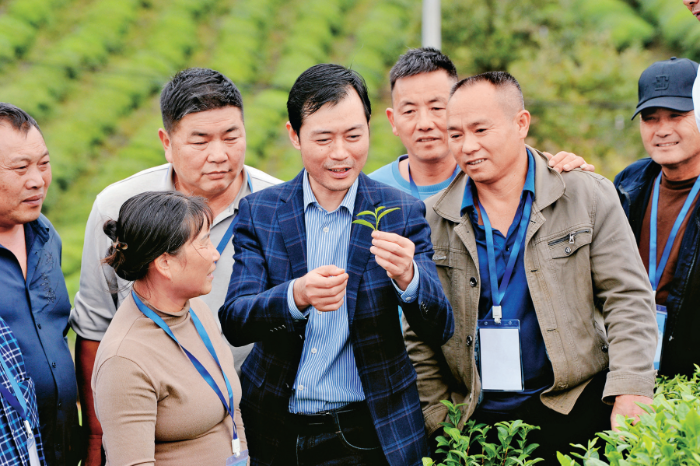
An expert (center) explains the prevention of cold injury for high-altitude tea plants to trainees in a farmer training program at Damao Mountain Tea Plantation in Dexing City, Jiangxi Province, November 11, 2025. PEOPLE’S DAILY / PHOTO BY ZHUO ZHONGWEI
In short, the gap between the development capacity of the rural population and the advancement of agricultural and rural modernization makes it difficult for advanced facilities, equipment, and technological models to play an effective role in actual production. Agricultural and rural modernization is thus confronted with the issues of “strong hardware but weak software” and “having available facilities but lacking the necessary talent.” Such issues have become major bottlenecks preventing agricultural and rural modernization from advancing toward higher quality.
II
In the process of modernization, people in rural areas face multiple challenges, caught in the dilemma of whether to move to cities or remain in the countryside. The dual urban-rural system creates various intertwining and overlapping constraints that further impede their well-rounded development. In addition, the fact that the rural migrant population cannot fully integrate into cities also holds back the advancement of new urbanization.
On the one hand, rural migrant workers find it difficult to integrate into urban life on an equal footing. Due to structural barriers to obtaining urban residency, nearly 300 million migrant workers commute between urban and rural areas year-round, forming a pattern similar to that of migratory birds. Moreover, migrant workers in cities often face invisible barriers in employment, social life, and other aspects because of their identity. Caught in an ambiguous position, they remain largely outside the reach of core urban public services and social networks, risking becoming a marginalized group within the city. Consequently, migrant workers have a relatively low sense of belonging and identity recognition.
Regarding education, children living with their migrant worker parents often have difficulty enrolling in urban public schools, and they often lack a sound home environment for learning. As for healthcare, the cross-regional transfer of medical insurance for migrant workers remains cumbersome and the reimbursement rate for off-site treatment is relatively low, resulting in inadequate coverage. Few migrant workers are included in the social security programs for urban employees, which makes it difficult for them to enjoy the same level of healthcare protection as urban residents.
Migrant workers are concentrated in informal jobs characterized by high intensity and low pay. Meanwhile, unable to afford the high housing prices in cities, many live in urban villages or bunkhouses, which dampens their hopes for a stable and dignified urban life.
On the other hand, opportunities for migrant workers returning to their hometowns are limited, making it difficult for them to find jobs in their villages. With the full integration of commercial services into agriculture and the comprehensive advancement of specialized division of labor across production processes, the traditional model of household farming has undergone a fundamental change. Relying solely on contracted land is no longer sufficient to sustain a stable livelihood. When migrant workers are unable to find development opportunities in cities and choose to return to their hometowns, they may still struggle to find work in the village.
Regarding industrial opportunities, emerging and distinctive industries in rural areas have yet to be developed, while traditional agriculture accounts for an excessively large share, resulting in a lack of sufficient high-quality jobs. Moreover, certain rural industrial projects lack professional management personnel and market-based operation mechanisms, rely excessively on policy support, and therefore have weak market competitiveness. As a result, these projects are unable to absorb a significant number of returning migrant workers.
In terms of resource guarantees, financial institutions, driven by risk concerns, are often reluctant to lend. As a result, the financing costs for small and micro enterprises in rural areas are significantly higher than those in urban areas. In most counties in the central and western regions, the loan-to-deposit ratio has long remained at a low level. Funds have trended toward flowing out of rural areas, and there is a relative lack of confidence and motivation for social capital to invest in agriculture and rural areas.
In the aspect of the capability of the returning migrant workers, they generally lack the specialized skills and digital literacy needed to adapt to modern agriculture and new forms of rural business. This makes it difficult for them to effectively participate in emerging sectors such as smart agriculture and rural e-commerce. At the same time, the success rate of entrepreneurship among returning migrant workers remains low, resulting in a mismatch between skills and industry needs.
It is also worth noting that, in recent years, the living requirements of rural residents have grown, exposing the inadequate capacity of public services in rural areas. Their expectations have evolved alongside economic and social development from basic material and cultural demands to a pursuit of a better life in all respects. However, the provision of corresponding public services and social security continues to fall short.
With regard to education, the number of primary schools and teachers in rural areas has significantly decreased nationwide, while high-quality educational resources have become concentrated in urban areas. As a result, rural students are disadvantaged in terms of instruction quality and opportunities for further education, as they struggle to obtain opportunities comparable to those available in urban areas. In the area of healthcare, the inadequacy of medical and health facilities in rural areas has yet to be fundamentally resolved. Rural doctors are also aging and lack successors to take their place. There remains a significant gap between rural and urban residents in healthcare accessibility, service quality, and coverage.
With regard to old-age security, a considerable disparity exists between the pension levels of rural residents and urban workers. Coupled with an imperfect social assistance and welfare system, the aging population presents considerable pressure on the system of eldercare. The development of cultural facilities in rural areas lags behind, and the supply of cultural products remains insufficient, making it difficult to meet the growing intellectual and cultural needs of rural residents.
In consumption, the large urban-rural income gap remains a major issue to be addressed. Rural areas are characterized by relatively low incomes and underdeveloped consumer markets, along with an insufficient supply of high-quality consumer goods. As a result, rural residents are still unable to fully enjoy the benefits of modern consumption.
III
The relatively low level of rural residents’ development is a concentrated reflection of the challenges characteristic of the current stage of development. This issue can be partially attributed to the fact that China, as a large developing country, found it necessary to prioritize strengthening its material foundation at a particular stage of development. Other more deep-seated factors include the shift in development philosophy, the improvement of institutional frameworks, innovations in governance mechanisms, and the structure of resource allocation.
First, path dependence that prioritizes physical assets over people has formed in the course of development. In the early stages of agricultural and rural modernization, policies focused on improving physical assets such as infrastructure, agricultural machinery and village facilities, with the aim of enhancing production capability and living conditions in rural areas. This was a reasonable decision at the time. However, such an approach has also led to certain ways of thinking and established working patterns. In some regions, as development has continued, tendencies have persisted to varying degrees to prioritize hardware over software, project implementation over talent cultivation, and short-term gains over long-term empowerment.
In contrast, far too little attention, resources, or effective efforts have gone into the foundational work that truly matters for the long-term development of rural residents and for instilling internal drive in them, such as transforming mindsets, enhancing their capabilities, and safeguarding their rights and interests. Once material development has reached a certain level, the shortcomings in rural residents’ development become increasingly evident, emerging as a key factor constraining the modernization of agriculture and rural areas.
Second, the institutional barriers created by the dual urban-rural structure have not yet been fundamentally removed. This is the deep-seated reason behind the constraints on the development of rural residents. The urban-rural dual management system, centered on the household registration system, is being gradually phased out, but the longstanding patterns in the allocation of production factors and the distribution of benefits remain deeply entrenched. The implicit connection between household registration and rights related to education, healthcare, social security, housing, and other areas creates invisible thresholds for the equal integration of the rural migrant population into cities.
As property rights and interests are concerned, rural residents do not have full ownership of their land, and unequal prices for urban and rural land designated for construction still exist despite equal rights. Furthermore, rural residents receive only a small proportion of the profits from the market-based transfer of rural collective land designated for business-related construction, and rural housing has yet to realize its full value as property. These factors prevent rural residents from accumulating capital for development through property income.
Another manifestation of the urban-rural divide is the social security system, with rural areas disadvantaged due to weak coordination and transfer mechanisms and a significant disparity in coverage. Among the nearly 300 million migrant workers, many remain without long-term labor contracts, living in a “semi-urbanized” state with unstable jobs and incomplete social security coverage, which increases their livelihood risks and mobility costs. These overlapping institutional barriers hinder the free movement of people and the equal exchange of factors between urban and rural areas.
Third, investment in rural human resources has lagged, and capacity development efforts do not align with the needs of the era. Modern agriculture, the digital economy, and innovations in social governance have placed greater demands on workers’ capabilities. However, the education and training system for rural residents geared toward the development of new quality productive forces has yet to be well established. Current training programs suffer from fragmented and outdated approaches and are poorly aligned with industrial and market needs, doing little to enhance rural residents’ digital literacy, technological application skills, management and operational capabilities, or innovative and entrepreneurial mindset.
Moreover, inadequate basic education resources in rural areas have impeded the early development of the younger generation’s capabilities. Rural areas are not attractive to skilled workers, lacking the industrial platforms, entrepreneurial ecosystems, and social environments needed for them, especially young people, to thrive. Consequently, rural areas find it difficult to attract and retain skilled individuals and often fail to make full use of their capabilities. These conditions further exacerbate the talent shortage in these areas.
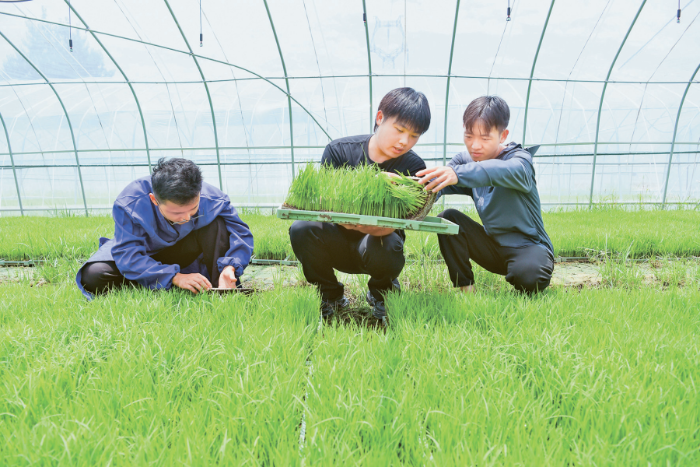
Young people born after 2000, now new farmers after returning to their hometown, examine late-season rice seedlings in a greenhouse in Xiangli Village, Jiangxi Province, June 9, 2025. PEOPLE’S DAILY / PHOTO BY ZHOU LIANG
Fourth, the mechanisms for ensuring the principal role of rural residents are still incomplete, and their internal drive for development has yet to be fully unleashed. In many rural development and governance practices, administrative approaches remain dominant in some areas, and the principal role of rural residents has yet to be fully realized.
In some places, key decisions on rural planning, industry selection, and project implementation are still made on behalf of residents, with public participation often reduced to a mere formality. These problems may lead to the misallocation of public resources, which fails to meet the actual needs of rural residents, resulting in an awkward situation in which the government is proactive, but the local people remain disengaged. This, in turn, weakens rural residents’ initiative and fosters a dependency mindset, characterized by reliance on external support. Without activating internal drive effectively, sustained increases in external inputs will be unable to generate lasting development momentum for the modernization of agriculture and rural areas.
IV
Considering the logical progression of China’s development, agricultural and rural development has undergone a historic leap from focusing on poverty alleviation to moderate prosperity in all respects, and now to all-around rural revitalization. It has now entered a new phase where the focus is shifting from the accumulation of material goods to the well-rounded personal development. This shift is indicative of the current stage of development, in which the focus once again centers on people themselves.
The Central Economic Work Conference held at the end of 2025 identified that it is essential to invest in both physical assets and people and this is a key principle for conducting economic work under the current circumstances. While continuing to invest in physical capital, it is crucial to invest more in people to promote comprehensive improvements in the perspectives, skills, rights, and interests of rural residents, thus generating lasting internal momentum for the modernization of agriculture and rural areas.
Based on institutional empowerment, we will break down the barriers between urban and rural rights and interests to ensure equal starting points for rural residents. Inequality of rights between urban and rural areas is a primary constraint on development opportunities of rural residents. Therefore, it is imperative to begin with institutional reform to enable rural residents to equally share in the fruits of modernization.
The key is to deepen reform of household registration system. In doing so, efforts should be made to gradually extend basic public services in urban areas to all permanent residents, and to improve access mechanism based on residence permits, length of residence, and social security contributions. Efforts should also be made to resolve the issue of “semi-urbanized” state of nearly 300 million migrant workers and their families in aspects such as children’s education, healthcare, and housing, thereby facilitating their integration into urban society.
Steady and prudent reform of the rural land systems is also essential. This includes exploring ways for collectively owned construction land to enter the market on equal terms with state-owned land, and establishing sound mechanisms to distribute value gains among rural residents, collectives, and the state. The rural governance system also needs to be improved to guarantee rural residents’ rights to be informed, to participate, to express their views, and to oversee matters related to rural planning and project construction, and public affairs. This hands-on participation will enhance rural residents’ awareness of their rights and their principal role, allowing them to turn from passive recipients into active participants in governance.
Through capacity building, we will promote the upgrading of human resources to adapt to changing times. As modernization ultimately manifests itself in the modernization of people’s knowledge, skills, and competencies, the development of rural residents has become an urgent task in responding to the shifts in the employment landscape brought about by the digital era.
A lifelong vocational skills training system for rural residents should be established to cover the entire lifecycle and align with market demands. Training should focus on practical areas such as modern agricultural technology, digital tools application, e-commerce operations, and management of cooperatives. Efforts should be made to strengthen linkages between training, certification, employment, and services, and to improve training effectiveness and the use of training outcomes. Particular measures should be taken to bridge the urban-rural digital divide by establishing village-level digital service stations, providing age-friendly coaching, and cultivating new types of farmers in the digital era, so as to help rural residents acquire basic digital literacy, including using smart devices, accessing and evaluating information, transacting online, and ensuring online security.
A rural workforce revitalization initiative will be launched, with strong policy incentives to attract and support college graduates, retired military personnel, and returning migrant workers to start businesses in their hometowns and rural areas. We will foster new agricultural business entities and develop leaders in rural industries. We will also establish mechanisms to link rural residents more closely through contracts, equity partnerships, and production trusteeship, integrating smallholders into the modern agricultural value chains. This will help accelerate their transition from manual laborers into modern, skilled operators.
Taking urban-rural integration as the pathway, we will promote the two-way flow of production factors between urban and rural areas and expand the potential space for development. The modernization of agriculture and rural areas is not a closed evolution confined to rural areas alone, but rather a systematic endeavor requiring urban-rural coordination. As such, we must break the entrenched pattern of the one-way flow of production factors and promote the transformation of urban-rural relations from one-way extraction to mutual empowerment.
To address the difficulty migrant workers face both in integrating into urban areas and returning to rural areas, the most effective response is to ensure equitable access to opportunities for them. We will develop an integrated intelligent matching platform for labor supply and demand at the county level to facilitate coordination of urban and rural labor resources. Policies supporting returnees starting businesses will be refined in areas such as financing, land use, and coordination of social security programs. This will create a more flexible environment with greater opportunities in both cities and hometowns, helping to mitigate structural employment risks arising from industrial transformation.
Furthermore, we will channel more financial resources toward agriculture and rural areas, innovate industrial chain finance and inclusive financial products to address the challenge of insufficient collateral in rural areas, and support the upgrade of distinctive rural industries and the development of infrastructure.
We will promote industrial coordination and functional complementarity between urban and rural areas. This includes developing new forms of business, such as leisure agriculture, rural tourism, and rural e-commerce, and promoting cultural exchange between urban and rural areas. In the course of modernization, we will protect and revitalize local rural culture, thereby enhancing the cultural confidence and social belonging of rural residents.
Guided by investment in people, we will optimize our policy system to stimulate internal drive for growth. The idea of well-rounded development of rural residents must be embedded in all aspects of the policy framework for agricultural and rural modernization.
Furthermore, we will optimize the structure of fiscal expenditure and significantly increase investments in “soft” areas essential to human resources, including education, training, healthcare, and social security. We will also explore a multi-channel funding mechanism led by the government that involves market and social forces.
In formulating and implementing rural policies, it is essential to adhere to the principle that rural development and revitalization are to benefit the rural residents. We must uphold their principal role, respect the pioneering spirit of the primary-level communities, and carefully consider such fundamental questions as “whether any initiatives we undertake align with rural residents’ wishes, whether they have a solid foundation of public support, and whether they safeguard the interests of rural residents.” By doing so, we will fully unleash the most vital and dynamic factor in rural productivity—the people—and stimulate the internal drive needed for agricultural and rural modernization.
This requires accelerating the establishment of a sound mechanism for dynamic policy evaluation, feedback, and adjustment to ensure the precise allocation of resources and stimulate the enthusiasm and creativity of rural residents in their pursuit of modernization.
Chen Wensheng is Vice President of the Chinese Society for Rural Development, and Dean of the China Rural Revitalization Research Institute at Hunan Normal University.
(Originally appeared in Qiushi Journal, Chinese edition, No. 4, 2026)