
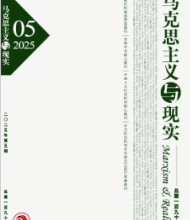
No.5 2025
CONTENTS
Feature: Research on Xi Jinping’s Cultural Thought
On the Epochal Imperatives, Theoretical Connotations, and Practical Pathways of the Historical Initiative Spirit // Zou Guangwen
The Ontological Question Underpinning Xi Jinping’s Cultural Thought // Song Youwen
The Significant Implications of Elevating Cultural Development to a More Prominent Position // Yang Hongyuan
Commemorating the 80th Anniversary of the Victory in the Chinese People’s War of Resistance against Japanese Aggression and the World Anti-Fascist War
A Multidimensional Analysis of the Communist Party of China’s Revolutionary Discourse during the War of Resistance against Japanese Aggression // Wang Haijun
Research on Xi Jinping Thought on Socialism with Chinese Characteristics for a New Era
The Contemporary Chinese Marxist Conception of Civilization and Its Theoretical Interpretation // Han Qingxiang & Xue Shengshan
Three Fundamental Questions in Comprehensively Deepening Reform in the New Era and Their Scientific Answers // Li Anzeng & Bi Xuehan
Spatial Logic: A Critique of, and Transcendence beyond, Western Modernization in Chinese Modernization // Kang Fengyun & Mai Zhongjian
Research on the Chinese Compilation and Translation of Classical Marxist Works
Engels’s Major Contributions to the Editing and Publication of Capital, Volume III (I)
Research on Fundamental Marxist Theories
Marx’s Theory of Capitalist Space: Based on the Grundrisse (1857-1858 Manuscripts)// Gong Jingcai
“Nostalgia” in the Context of Marx’s Philosophy of Social Space: Dimensions of Its Significance for Building a “People’s City” // Li Chunmin
The Evolution of Utilitarianism in Marx’s Early Writings // Zhou Yang
The Community Constituted by Human Freedom: Kant and Marx // Huang Ge
Recognition of Nature and of the Self: On the Formation of Human Selfhood in Ecological Civilization // Cao Mengqin & Wang Yibing
Research on Political Economy with Chinese Characteristics
Regulating and Guiding the Healthy Development of Capital from the Perspective of Marx’s Theory of Capital: A Labor-Capital Relation Dimension // Feng Jikang & Zhu Yan
The Significance, Connotations, and Pathways of an Evaluation System for State-Owned
Enterprises’ Fulfillment of Strategic Missions // Xiao Bin & Ma Luyao
Key Issues in Promoting the High-Quality Development of Private Enterprises // Kuang Xiaolu & Xie Fusheng
Research on the History of Marxism
Lenin’s “Plan” for Research on the Ground Rent Chapters of Marx’s Capital: Based on
Lenin’s Critique of the “Legal Marxist” Theory of Rent // Yang Wenliang
Research on Contemporary Capitalism
A Triple-Dialectical Analysis of the Eastern European Left’s Critique of Patchwork Capitalism: Historical Formation, Critical Orientation, and Theoretical // LimitationsSun Jianyin
A Critique of the Capital Logic of Capitalist Modernization and Its Three Manifestations //
Li Xuejiao & Wang Chenyang
Identity Politics, Liberalism, and the Crisis of Capitalism // Wang Yue
Research on Marxism Abroad
G. A. Cohen on Marx’s Historical Materialism as a Transcendence of Hegel’s Philosophy of History // Duan Zhongqiao
Is Marx’s Ethics a Form of Virtue Ethics? A Discussion Centered on George G. Brenkert // Ye Fangxing
Is Marxism Transhumanism? Reflections from the Perspective of the Human-Technology Relationship //Yan Jinqi
Academic Developments
Advancing Shared Development within the Global South through Chinese Modernization: A Review of Studies on Chinese Modernization in Latin America // He Qin
MAIN ABSTRACTS
On the Epochal Imperatives, Theoretical Connotations, and
Practical Pathways of the Historical Initiative Spirit
Zou Guangwen
At this critical juncture in building a great country in all respects and realizing national rejuvenation through Chinese modernization, cultivating and promoting the historical initiative spirit has become an imperative of the era. In the mutual learning among civilizations, sustaining Chinese cultural subjectivity hinges on advancing this spirit. In the inheritance and development of culture, the creative transformation and innovative development of the best of traditional Chinese culture inherently demand its cultivation. In the grand practice of advancing Chinese modernization, accurately grasping the laws of building socialism with Chinese characteristics and steadfastly following China’s own path require strengthening this spirit as a vital guarantee. Theoretically, as the objectification of human subjective consciousness in social-historical development, the historical initiative spirit denotes an ideological consciousness through which human beings dynamically influence and shape the historical process by apprehending the laws of historical development. Practically, through a century of struggle, the Communist Party of China has successfully opened a path to socialist modernization with Chinese characteristics—an achievement attributable to the consistent upholding and promotion of the historical initiative spirit.
The Ontological Question Underpinning Xi Jinping’s Cultural Thought
Song Youwen
“Who am I, where do I come from, and where am I going?” represents the ontological inquiry within Xi Jinping’s cultural thought. Elevating this inquiry to the level of a fundamental question and providing a cogent response are essential for deepening the systematic and theoretical study of Xi Jinping’s cultural thought. This ontological inquiry integrates three core dimensions—cultural identity, cultural confidence, and cultural mission—forming an interconnected and progressive framework. It profoundly elucidates the historical trajectory and civilizational orientation of China, embodies the unity of the Marxist view of history and culture, and reflects the convergence of the Communist Party of China’s cultural leadership with China’s cultural subjectivity, thereby constituting the philosophical foundation of this important body of thought.
The Significant Implications of Elevating Cultural Development
to a More Prominent Position
Yang Hongyuan
A defining feature of Xi Jinping’s cultural thought is its heightened prioritization of cultural development. This body of thought emphasizes the material force of culture and its pivotal role in integrating economic, political, cultural, social, and ecological advancement into a unified praxis. It entails a deep grasp of culture’s educative and governance functions and the creative transformation and innovative development of China’s tradition of cultural governance through the cultivation and practice of core socialist values. It further posits that cultural development should be people-centered rather than object-centered, aiming to meet the people’s diverse, multi-level, and multifaceted ethical and cultural needs, thereby substantively enhancing their sense of cultural fulfillment and wellbeing. It also calls for safeguarding cultural and ethical independence and consolidating cultural subjectivity amid the turbulent currents of world cultures, thus laying a solid cultural foundation for the rejuvenation of the Chinese nation.
The Contemporary Chinese Marxist Conception of
Civilization and Its Theoretical Interpretation
Han Qingxiang & Xue Shengshan
As a philosophical inquiry into the fundamental problems of civilization, the concept of civilization concerns how a civilization understands itself, apprehends others, and positions itself in the world; it also shapes the overall trajectory of the progress of civilization. The contemporary Chinese Marxist conception of civilization seeks to elucidate the Communist Party of China’s systematic views and methodologies—particularly in the New Era—regarding core civilizational questions, while foregrounding its distinctions from contemporary Western conceptions across historical, theoretical, practical, and philosophical dimensions. By interrogating a series of logically interlinked foundational issues—including the essence, criteria, goals, paths, paradigms, direction, the civilization–culture nexus, and the philosophical foundations of civilization—we can expose the divergences in civilizational outlooks that underpin Chinese and Western civilizational formations and their substantive cores. This, in turn, enables an objective assessment of which civilizational model—Chinese or Western—is better positioned to address global challenges, align with the spirit of the times, advance the progress of civilization, and pioneer new models for human advancement amid unprecedented changes unseen in a century.
A Multidimensional Analysis of the Communist Party of
China’s Revolutionary Discourse during the War of
Resistance against Japanese Aggression
Wang Haijun
The pursuit of external discursive power and the construction of an external discourse system constitute important dimensions of the Communist Party of China’s efforts to shape its international image. During the War of Resistance against Japanese Aggression, in order to counter the Kuomintang’s ideological smears and dispel international suspicion, the Party actively articulated progressive revolutionary themes and crafted an outward-facing revolutionary discourse. Through multifaceted efforts, it forged a comprehensive discourse system endowed with strong communicative efficacy and appeal, effectively shaping a multidimensional, objective, and authentic revolutionary image. Theoretical exploration of the CPC’s construction of revolutionary discourse during this period offers valuable insights for telling China’s story well and shaping a positive international image on the new journey in the New Era.
Three Fundamental Questions in Comprehensively
Deepening Reform in the New Era and Their
Scientific Answers
Li Anzeng & Bi Xuehan
Since the 18th National Congress of the Communist Party of China, Xi Jinping has creatively explored and answered a series of fundamental questions concerning comprehensively deepening reform in the New Era. These include: from an ontological perspective, revealing the essential nature of comprehensively deepening reform and answering what comprehensively deepening reform is; from the standpoint of practice theory, examining the principles, methods, and pathways of comprehensively deepening reform and answering how to comprehensively deepen reform; and from an axiological perspective, elucidating its fundamental stance, contemporary value, and global significance, thereby answering how to evaluate comprehensively deepening reform. An in-depth study of General Secretary Xi Jinping’s new ideas, viewpoints, and judgments on comprehensively deepening reform, alongside a rigorous theoretical analysis of these three fundamental questions, holds major theoretical significance and practical value for opening new horizons in further deepening reform and for comprehensively advancing the building of a great country and the great cause of national rejuvenation through Chinese modernization.
英文目录和摘要审校 童孝华
No.5 2025
- No. 6 2025
- No. 5 2025
- No. 4 2025
- No. 3 2025
- No. 2 2025
- No. 1 2025
- No. 6 2024
- No. 5 2024
- No. 4 2024
- No. 3 2024
- No. 2 2024
- No. 1 2024
- No. 6 2023
- No. 5 2023
- No. 4 2023
- No. 3 2023
- No. 2 2023
- No. 1 2023
- No. 6 2022
- No. 5 2022
- No. 4 2022
- No. 3 2022
- No. 2 2022
- No. 1 2022
- No. 6 2021
- No. 5 2021
- No. 4 2021
- No. 3 2021
- No. 2 2021
- No. 1 2021